 Jitendra Singh
India has doubled power generation through Nuclear Energy in last decade: Jitendra Singh
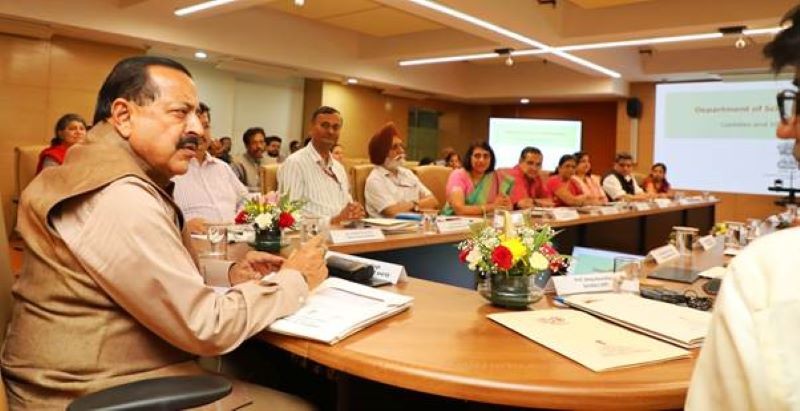
Union Minister Jitendra Singh on Wednesday said India's Nuclear power generation capacity has grown significantly in last one decade, nearly doubling from 4,780 MW in 2014 to 8,180 MW in 2024.
This was disclosed in the Lok Sabha by Union Minister of State (Independent Charge) for Science and Technology, Minister of State (Independent Charge) for Earth Sciences, MoS PMO, Department of Atomic Energy, Department of Space, Personnel, Public Grievances and Pensions, Dr. Jitendra Singh addressed the Lok Sabha in response to a discussion on Nuclear power.
The Minister highlighted the significant progress and future potential of India's atomic energy program.
He elaborated on key developments and outlined a roadmap for achieving greater self-reliance in nuclear power generation.
Dr. Jitendra Singh emphasized the revision of India’s power distribution framework, which has increased the home state’s share of electricity from atomic plants to 50%, with 35% allocated to neighboring states and 15% to the national grid.
This new formula ensures equitable resource distribution and reflects the federal spirit of the nation, Singh said.
While highlighting how India’s Nuclear power generation capacity has grown significantly, nearly doubling from 4,780 MW in 2014 to 8,180 MW in 2024, Dr Jitendra Singh added that the capacity is projected to triple to 22,480 MW by 2031-32, showcasing India’s commitment to scaling up its nuclear energy infrastructure.
The Union Minister attributed this progress to several transformative initiatives, including the bulk approval of 10 reactors, increased funding allocations, collaborations with Public Sector Undertakings (PSUs), and limited private sector participation. He credited advancements in technology and streamlined administrative processes for strengthening India’s nuclear infrastructure.
In addition to energy production, Dr. Jitendra Singh highlighted the diverse applications of atomic energy.
He noted its extensive use in agriculture, including the development of 70 mutagenic crop varieties. In the healthcare sector, India has introduced advanced isotopes for cancer treatment, while in the defence sector, atomic energy processes have been used to develop cost-effective, lightweight bulletproof jackets.
The Union Minister also underscored India’s abundant thorium reserves, which constitute 21% of the global total. Indigenous projects like "Bhavani" are being developed to harness this resource, reducing dependence on imported uranium and other materials.
He acknowledged the challenges in implementing atomic power projects, such as land acquisition, forest clearances, and equipment procurement, but reaffirmed the government’s commitment to addressing these issues.
He said that nine atomic power projects are currently under construction, with several others in the pre-project stage, demonstrating India’s dedication to expanding nuclear energy capacity.
Dr. Jitendra Singh provided a historical perspective, highlighting projects like the Kudankulam Nuclear Power Plant, which gained momentum post-2014 under the leadership of Prime Minister Narendra Modi.
He reiterated India’s commitment to peaceful purposes of atomic energy, as envisioned by Dr. Homi Bhabha, and emphasized leveraging nuclear energy for sustainable development while aligning with the vision of "One Nation, One Government."
This progress underscores India’s resolve to achieve energy self-sufficiency, drive innovation, and contribute significantly across sectors through the peaceful applications of nuclear energy.
Support Our Journalism
We cannot do without you.. your contribution supports unbiased journalism
IBNS is not driven by any ism- not wokeism, not racism, not skewed secularism, not hyper right-wing or left liberal ideals, nor by any hardline religious beliefs or hyper nationalism. We want to serve you good old objective news, as they are. We do not judge or preach. We let people decide for themselves. We only try to present factual and well-sourced news.
Support objective journalism for a small contribution.