 Modi-Netanyahu
Safety of civilians must remain a top priority: Modi tells Netanyahu during telephone conversation
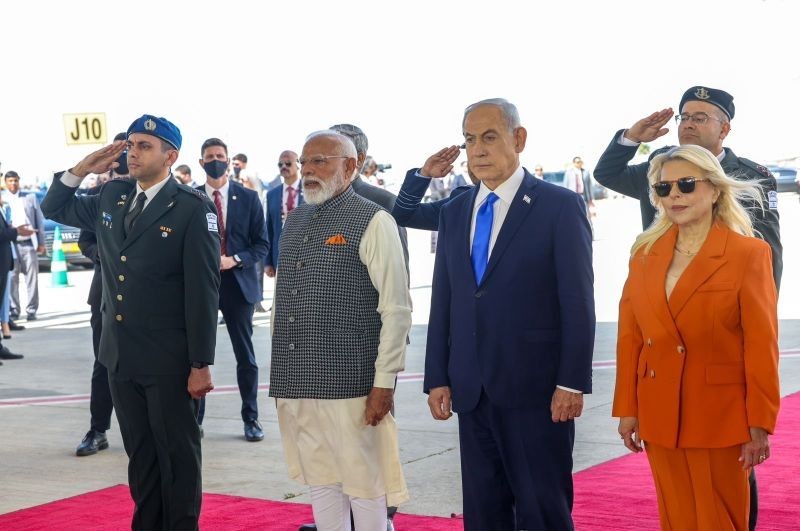
Prime Minister Narendra Modi on Monday held a telephone conversation with his Israeli counterpart Benjamin Netanyahu to discuss the rapidly escalating situation in the Middle East following joint military strikes by Israel and the United States on Iran.
“Had a telephone call with PM Benjamin Netanyahu to discuss the current regional situation,” Modi said in a post on X after the call.
He added that India conveyed its concerns over the recent developments and stressed that the safety of civilians must remain a top priority. “India reiterates the need for an early cessation of hostilities,” the Prime Minister said.
A day earlier, Modi spoke with UAE President Sheikh Mohamed bin Zayed Al Nahyan, strongly condemning the recent attacks on the Gulf nation and expressing India’s solidarity during the ongoing crisis.
“Spoke with President of the UAE, my brother Sheikh Mohamed bin Zayed Al Nahyan. Strongly condemned the attacks on the UAE and condoled the loss of lives in these attacks. India stands in solidarity with the UAE in these difficult times,” Modi wrote on X.
Had a telephone call with PM Benjamin Netanyahu to discuss the current regional situation. Conveyed India's concerns over recent developments and emphasised the safety of civilians as a priority. India reiterates the need for an early cessation of hostilities.@netanyahu
— Narendra Modi (@narendramodi) March 1, 2026
He reiterated India’s support for de-escalation and efforts aimed at ensuring regional peace, security and stability, and thanked the UAE leadership for safeguarding the Indian community residing in the country.
Meanwhile, the UAE’s Ministry of Defence confirmed that three people were killed and 58 others sustained minor injuries after Iran launched retaliatory attacks following joint military operations by Israel and the United States that reportedly resulted in the death of Iran’s Supreme Leader Ali Khamenei.
In a statement posted on X, the Ministry said 541 Iranian drones were detected, of which 506 were intercepted and destroyed, while 35 fell within the country, causing material damage.
The fatalities included nationals from Pakistan, Nepal and Bangladesh. The injured comprised Emirati, Egyptian, Ethiopian, Filipino, Pakistani, Iranian, Indian, Bangladeshi, Sri Lankan, Azerbaijani, Yemeni, Ugandan, Eritrean, Lebanese and Afghan nationals.
The Ministry further said that the UAE Air Force and Air Defence Forces have intercepted 165 ballistic missiles, two cruise missiles and 541 drones since the start of the Iranian assault.
On the second day of the attack, air defence systems destroyed 20 ballistic missiles, while eight reportedly fell into the sea. Authorities also intercepted two cruise missiles and 311 drones, though 21 drones struck civilian targets.
The Ministry asserted that the UAE’s air defence systems remain fully capable of countering a broad range of aerial threats.
Separately, Iran appointed Ayatollah Alireza Arafi to its interim leadership council, hours after officially announcing the death of Supreme Leader Ali Khamenei.
Khamenei was reportedly killed in a strike carried out by Israel and the United States on Saturday inside Iranian territory.
Support Our Journalism
We cannot do without you.. your contribution supports unbiased journalism
IBNS is not driven by any ism- not wokeism, not racism, not skewed secularism, not hyper right-wing or left liberal ideals, nor by any hardline religious beliefs or hyper nationalism. We want to serve you good old objective news, as they are. We do not judge or preach. We let people decide for themselves. We only try to present factual and well-sourced news.
Support objective journalism for a small contribution.