"India can’t grow without exports," Kant warns, as geopolitics, protectionism reshape global trade
Kolkata/IBNS: The era of relative global stability that followed World War II has ended, leaving exporters to navigate a world shaped by geopolitics, protectionism and rapid technological change, G20 Sherpa and former NITI Aayog CEO Amitabh Kant said.
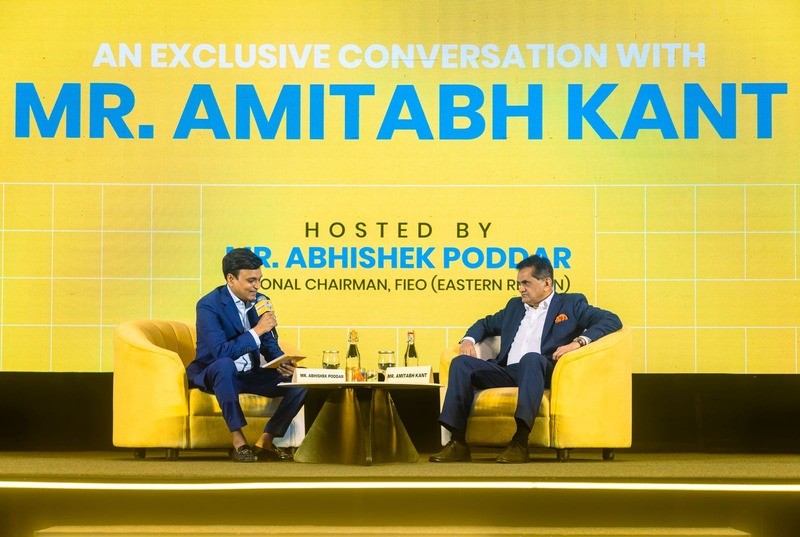
The Federation of Indian Export Organisations (FIEO), Eastern Region, hosted an exclusive conversation with Kant at ITC Sonar Bangla in Kolkata on Sunday, bringing together exporters, industry leaders and policymakers for a focused dialogue on India’s trade strategy amid a rapidly evolving global economic landscape.
The event was hosted by Abhishek Poddar, regional chairman, FIEO (Eastern Region), and addressed the structural, geopolitical and policy challenges confronting Indian exporters from rising protectionism and tariff barriers to global supply-chain realignments and the urgent need for competitiveness-led reforms.
“The period of post-war stability has come to an end,” Kant said, arguing that institutions such as the UN Security Council and the World Trade Organization “have become redundant” as they failed to evolve.
He pointed to prolonged conflicts in Europe and the Middle East as evidence that the old global order no longer holds.
Kant said the earlier phase of globalisation, which allowed Japan, South Korea and China to grow at double-digit rates for decades, was driven by free trade, low tariffs and expanding global value chains.
That environment, he said, has now shifted to protectionism and the “weaponisation of tariffs,” breaking supply chains and changing the rules of export-led growth.
“India can’t grow without exports,” he said, stressing that exports remain critical to sustaining high economic growth.
China model and India opportunity
Explaining China’s export strategy, Kant said Beijing focused on dominating select sectors through size and scale, efficient ports, logistics and just-in-time manufacturing.
“China believes only in exports. It does not believe in imports,” he said, adding that penetrating the Chinese market remains extremely difficult.
Kant said China’s gradual shift away from labour-intensive manufacturing towards high-tech sectors presents an opportunity for India, particularly in Asian markets.
He noted that China exports about $900 billion to Asia, while India’s exports to the region remain far lower. “Looking east gives India a huge opportunity,” he said.
“Geopolitics will make it very difficult for American companies to produce in China in the long run,” he said hinting at the unreal tariffs imposed by the US.
Free enterprise and state-led growth
On domestic reforms, Kant called for dismantling excessive regulations and licensing systems, arguing that a lingering “socialistic mindset” continues to hinder growth.
“Government is not a creator of wealth. It should be a facilitator,” he said, adding that private enterprise must drive innovation and expansion.
Kant said India cannot become a $30 trillion economy unless at least 12 states grow at 10% or more.
He urged states such as Uttar Pradesh, Bihar and West Bengal to eliminate outdated rules, digitise approvals and create plug-and-play manufacturing ecosystems.
Technology, R&D and clean energy
Kant said future competitiveness will depend on advanced technologies such as artificial intelligence, semiconductors, quantum computing and green energy.
He criticised India’s private sector for underinvesting in research and development, noting that R&D spending remains below 1% of GDP.
“R&D cannot succeed if it is driven only by government institutions,” he said, calling for innovation to be anchored in universities and backed by private capital.
Highlighting India’s renewable energy push, Kant said the country has already installed 256 GW of renewable capacity and has the potential to become a global leader in clean energy and green hydrogen.
“India has a prospect to become the top provider of clean energy in the world,” he said.
Exports, energy security and AI
Defending India’s crude oil imports from Russia, Kant said energy security is critical for sustaining growth and controlling inflation. He argued that affordable energy has helped India grow at high rates while keeping inflation relatively low.
Looking ahead, Kant identified artificial intelligence as a foundational technology that will determine global leadership over the next few decades.
He warned against “colonialism in a new form” through proprietary AI models and called for open-source systems with strong data privacy safeguards.
“The AI race has just begun,” he said, adding that India must build its own open, interoperable models to remain competitive.
Kant concluded that India’s next phase of growth will depend on export competitiveness, state-level reforms, technology adoption and world-class cities.
“The heavy lifting has been done by the Centre,” he said. “Now it’s up to the states and the private sector to carry the vision forward.”
Support Our Journalism
We cannot do without you.. your contribution supports unbiased journalism
IBNS is not driven by any ism- not wokeism, not racism, not skewed secularism, not hyper right-wing or left liberal ideals, nor by any hardline religious beliefs or hyper nationalism. We want to serve you good old objective news, as they are. We do not judge or preach. We let people decide for themselves. We only try to present factual and well-sourced news.