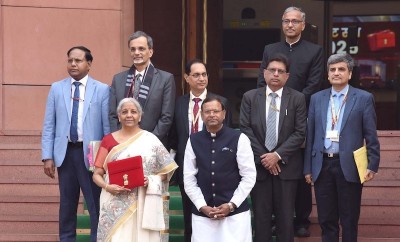
Rationalisation of subsidies will release resources for public investment in agriculture: Economic Survey
An amount of Rs. 107823.75 crore has been released as Food Subsidy during the year 2014-15 (upto January 9, 2015). This is a substantial increase of 20.15% over 2013-14 when an amount of Rs. 89740 crore was released as food subsidy.
Provision of minimum nutritional support to the poor through subsidized foodgrains and ensuring price stability in different states are the twin objectives of the food security system.
The Economic Survey states that while the economic cost of wheat and rice has continuously gone up, the issue price has been kept unchanged since July 1, 2002. This has resulted in large amounts of subsidy on foodgrains distributed through the TPDS/NFSA and other welfare schemes.
The Economic Survey also states that agriculture and food sector needs huge investment in research, education, extension, irrigation, fertilizers, and laboratories to test soil, water and commodities, warehousing, cold-storage. Rationalization of subsidies and better targeting of beneficiaries would release resources for public investment in agriculture.
The survey opines that the focus of public expenditure for agriculture so far has been on provision of subsidies (public expenditure in agriculture is only one-fourth of expenditure towards food and fertilizer subsidies, CACP Kharif report 2014-15) and it is time it shifted towards investments to boost productivity. Recommendations of Shanta Kumar Committee provide useful suggestions for the future road-map of food-policy, says the Economic Survey.
Support Our Journalism
We cannot do without you.. your contribution supports unbiased journalism
IBNS is not driven by any ism- not wokeism, not racism, not skewed secularism, not hyper right-wing or left liberal ideals, nor by any hardline religious beliefs or hyper nationalism. We want to serve you good old objective news, as they are. We do not judge or preach. We let people decide for themselves. We only try to present factual and well-sourced news.