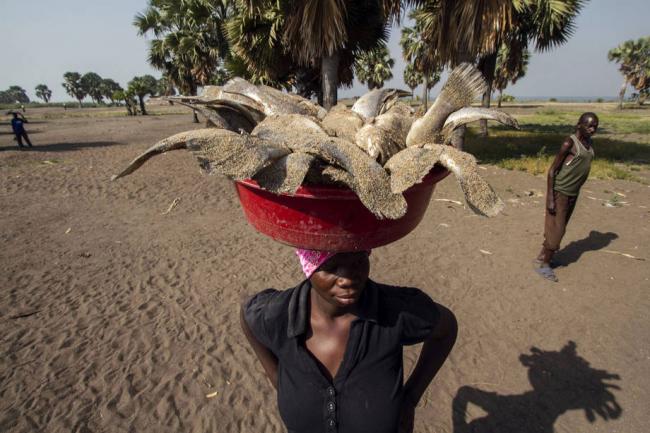
UN agency puts fast-growing fish trade on the ‘sustainability’ menu
Lower-income nations’ exports of fish and fishery products reached $78 billion in 2014, more than triple the value of global rice exports, according to the United Nations Food and Agriculture Organization (FAO).
“Sustainably serving those lucrative markets is of critical importance to developing countries, where most fish are produced, whether caught in the wild or grown in cages or farm ponds,” the agency’s news release says.
The biennial high-level meeting of FAO’s Sub-Committee on Fish Trade, being held in Agadir through Friday, 26 February, has drawn delegations of fisheries ministries from more than 50 countries to discuss emerging governance needs of the fisheries sector.
“Trade in fish is much more important than people think, both in absolute and relative terms,” said Audun Lem, Deputy-Director in FAO’s Fisheries and Aquaculture Policy and Resources Division, who serves as Secretary of the meeting.
Dialogues will help FAO, its member countries and industry representatives understand new trends, opportunities and challenges in the fishing sector, fostering the development of strategies that can “best position developing countries to develop their fisheries sectors in a sustainable manner and to maximize their economic benefit from the growth we expect to witness,” Lem said.
Traceability
One major topic for consideration is how to better trace products throughout the supply chain. Ministers are poised to agree on FAO’s proposed technical guidelines for catch documentation schemes, a set of documents testifying to the legal origin of the catch. This could become an important tool in curbing illegal fishing, a target concerning the conservation and sustainable use of the oceans, seas and marine resources under Goal 14 of the 2030 Agenda for Sustainable Development adopted by the UN General Assembly in September 2015.
Central to the effort is FAO’s Agreement on Port State Measures to Prevent, Deter and Eliminate, Illegal, Unreported and Unregulated Fishing, which has now been ratified by 21 nations and is on course to have the 25 national ratifications required to enter into full legal force by the time the Committee on Fisheries, an intergovernmental forum, meets in July.
Work will also focus on harmonizing certification requirements for fish exports to major international markets, where consumers as well as retailers are becoming more alert to quality, safety and legality concerns.
Emerging Trends
New trends will also be among the subjects at the Agadir meeting. Aquaculture output has more than tripled to 78 million tonnes over the past 20 years, making it the world’s fastest-growing food producing sector. FAO expects wild-caught fish to grow modestly in volume terms while its share of the market for human consumption declines to 38 per cent in 2030.
While most fish farms are in Asia, aquaculture's highest growth rates have of late been in Africa and South and Central America, where its marginal contribution to food security can be higher than elsewhere precisely due to the fact that per-capita consumption of fish in these emerging regions has traditionally been low.
Aquaculture, typically far less seasonal and volatile than open-sea fishing, can help food waste be minimized and food safety enhanced, and investments in cold-storage facilities incentivized, all enabling supermarkets to plan and guarantee procurement.
The seafood menu is also changing in many ways, as exemplified by the fact that, for the first time in history, more fresh tuna was flown to the US than to Japan.
Shifts in age-old patterns are likely to become a common feature in the future of fish, especially as developing countries increase their share of world imports. Since 2013, salmon and trout have replaced shrimp as the most important commodity traded in value terms.
Photo: FAO/Isaac Kasamani
Support Our Journalism
We cannot do without you.. your contribution supports unbiased journalism
IBNS is not driven by any ism- not wokeism, not racism, not skewed secularism, not hyper right-wing or left liberal ideals, nor by any hardline religious beliefs or hyper nationalism. We want to serve you good old objective news, as they are. We do not judge or preach. We let people decide for themselves. We only try to present factual and well-sourced news.