


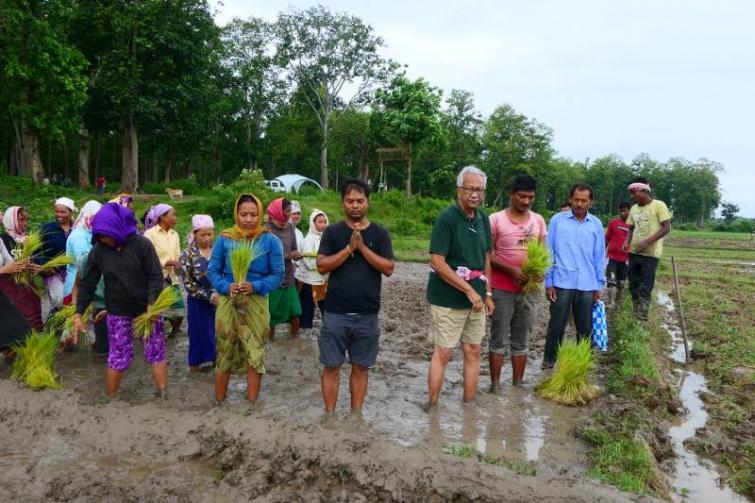
Assam villagers donate 200 bigha land to create meal zone for wild elephants
Guwahati, Aug 13 (IBNS): A cluster of villages in Assam’s Nagaon district have found a way to reduce the Man-Elephant conflict and keep their crop by setting aside a meal zone for the wild elephants.
Around 600 poor farmers of 12 villages in the Ronghang and Hatikhali area in the central Assam district have donated 203 bigha (around 33 acres) of community land and took turns to plant paddy exclusively for the elephants that often come down the hills of the adjoining Karbi Anglong district.
Every year, the wild elephants come down the hills in search of foods and destroy the paddy fields of the farmers of the area.
Many wild jumbos and people have died in the Man-Elephant conflict in the area in past times.
Aiming to reduce the Man-Elephant conflict, environmentalist Binod Dulu Bora – a local youth had taken an initiative and held 18 meetings with the villagers of Ronghang and Hatikhali area and urged them to plant paddy exclusively for the wild elephants.
.jpg)
Following this appeal, the poor villagers had decided to donate their lands to convert it for a meal zone for the elephants.
Not only paddy, the Hatibondhu NGO has planted saplings of 2,000 outenga (elephant apple), 1,500 jackfruit and 25,000 banana plants for the wild elephants in the area.
Binod Dulu Bora said that, growing paddy for elephants was the idea of Pradip Kumar Bhuyan – the director of Hatibondhu.
“We ‘Hatibondhu’ found that, the Man-Elephant conflict has gradually increased in search of foods. If we grow paddy for the elephants, then the elephants will eat it and they will not enter in the human habitats. It will help to reduce the Man-Elephant conflict. With the help of Pradip Kumar Bhuyan sir, we held at least 18 meetings with the villagers and convinced them and aimeding to plant paddy in around 200 bigha lands. We had also cultivated napier grass in 45 bigha lands for the elephants,” Binod Dulu Bora said.
On the other hand, Hatibondhu director Pradip Kumar Bhuyan said that, the villagers of Ronghang have donated 200 bigha lands to plant paddy for the elephants.
“Man-Elephant conflicts are going on and many elephants have died and also many people. We have started to plant paddy for the elephants,” Pradip Kumar Bhuyan said.
(By Hemanta Kumar Nath, Guwahati)
Support Our Journalism
We cannot do without you.. your contribution supports unbiased journalism
IBNS is not driven by any ism- not wokeism, not racism, not skewed secularism, not hyper right-wing or left liberal ideals, nor by any hardline religious beliefs or hyper nationalism. We want to serve you good old objective news, as they are. We do not judge or preach. We let people decide for themselves. We only try to present factual and well-sourced news.
Support objective journalism for a small contribution.


