


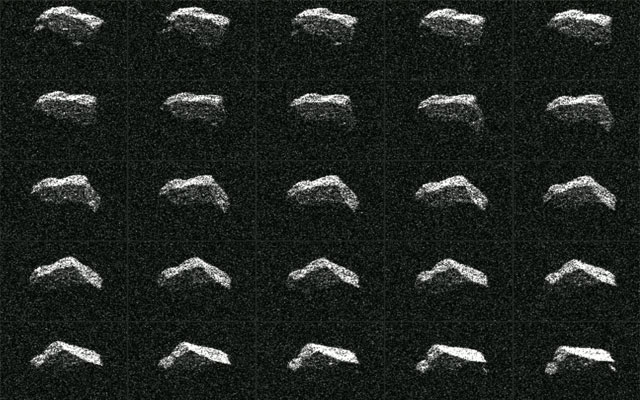
Asteroid resembles dungeons and dragons dice
They reveal an irregular, angular-appearing asteroid about 660 feet (200 meters) in size that rotates about once every three hours.
The images have resolutions as fine as 12 feet (3.75 meters) per pixel.
“The radar images show relatively sharp corners, flat regions, concavities, and small bright spots that may be boulders,” said Lance Benner of NASA’s Jet Propulsion Laboratory in Pasadena, California, who leads the agency’s asteroid radar research program. “Asteroid 2017 BQ6 reminds me of the dice used when playing Dungeons and Dragons. It is certainly more angular than most near-Earth asteroids imaged by radar.”
Asteroid 2017 BQ6 safely passed Earth on Feb. 6 at 10:36 p.m. PST (1:36 a.m. EST, Feb. 7) at about 6.6 times the distance between Earth and the moon (about 1.6 million miles, or 2.5 million kilometers). It was discovered on Jan. 26 by the NASA-funded Lincoln Near Earth Asteroid Research (LINEAR) Project, operated by MIT Lincoln Laboratory on the Air Force Space Command’s Space Surveillance Telescope at White Sands Missile Range, New Mexico.
Radar has been used to observe hundreds of asteroids. When these small, natural remnants of the formation of the solar system pass relatively close to Earth, deep space radar is a powerful technique for studying their sizes, shapes, rotation, surface features, and roughness, and for more precise determination of their orbital path.
NASA's Jet Propulsion Laboratory, Pasadena, California, manages and operates NASA’s Deep Space Network, including the Goldstone Solar System Radar, and hosts the Center for Near-Earth Object Studies for NASA's Near-Earth Object Observations Program within the agency's Science Mission Directorate.
JPL hosts the Center for Near-Earth Object Studies for NASA's Near-Earth Object Observations Program within the agency's Science Mission Directorate.
Image Credits: NASA/JPL-Caltech/GSSR
Support Our Journalism
We cannot do without you.. your contribution supports unbiased journalism
IBNS is not driven by any ism- not wokeism, not racism, not skewed secularism, not hyper right-wing or left liberal ideals, nor by any hardline religious beliefs or hyper nationalism. We want to serve you good old objective news, as they are. We do not judge or preach. We let people decide for themselves. We only try to present factual and well-sourced news.
Support objective journalism for a small contribution.


