


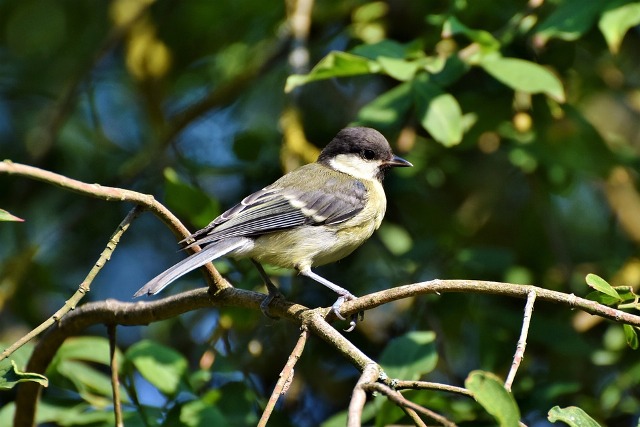
Common songbird population could collapse within this century due to rising temperatures, MU study finds
New York, Aug 24 (IBNS): Previous research has shown that higher temperatures fueled by climate change could have major impacts on birds in the U.S. that are already considered threatened.
Now, researchers at the University of Missouri have found that the Acadian flycatcher, a common songbird in the U.S., is at risk of severe population decline across the 96-million acre Central Hardwoods Region within the century if the climate continues to warm.
“This is a bird that is common in the Midwest,” said Thomas Bonnot, an assistant research professor in MU’s School of Natural Resources. “The possibility that an abundant species could approach near-extinction from the region within 90 years clearly demonstrates the significant impact of a warming climate on songbird populations.”
Bonnot partnered with his former advisor at MU, Frank Thompson of the U.S. Forest Service’s Northern Research Station, who has spent more than 20 years researching the Acadian flycatcher. This data, which identified the negative effects of higher temperatures on breeding productivity at an individual level, was incorporated into models that projected both individual bird reproduction and overall population growth under future conditions of climate change. The projections ran through the year 2100 and showed that a warming climate would have severe impacts on breeding success, threatening the flycatcher population.
Under a scenario in which climate change continues at its current pace, the researchers found that the songbird’s breeding productivity would fall below 1 fledgling per female by 2100, severely weakening the population. However, breeding productivity was less affected under a different scenario that would entail lowering greenhouse gas emissions and stabilizing the course of climate warming. According to Bonnot, this indicates humans could help conserve the population by applying the correct conservation approach, such as directly addressing climate change.
“The more we understand about how higher temperatures affect various species, the better we can plan conservation efforts,” Bonnot said. “Habitat restoration, for example, may not be enough on its own; the impacts we observed on the flycatcher occurred even with adequate habitat. A more comprehensive approach that finds other ways to boost breeding success is needed to combat a threat as large-scale as rising temperatures.”
Bonnot said other birds may face similar threats, but more research is needed before the effects of climate change on those populations can be similarly projected. For now, the focus is on finding ways to mitigate potential population loss, such as reducing forest fragmentation.
The study, “Threat of climate change on a songbird population through its impacts on breeding,” was published in Nature Climate Change. In addition to Bonnot and Thompson, other researchers involved in the study were Andrew Cox of the Florida Fish and Wildlife Commission and Joshua J. Millspaugh of the University of Montana.
The School of Natural Resources is located in the MU College of Agriculture, Food and Natural Resources.
Funding was provided by the U.S. Forest Service Northern Research Station, the U.S. Geological Survey National Climate Adaptation Science Center, the Department of the Interior’s Northeast Climate Adaptation Science Center and the Gulf Coastal Plains and Ozarks Landscape Conservation Cooperative. The content is solely the responsibility of the authors and does not necessarily represent the official views of the funding agencies.
Support Our Journalism
We cannot do without you.. your contribution supports unbiased journalism
IBNS is not driven by any ism- not wokeism, not racism, not skewed secularism, not hyper right-wing or left liberal ideals, nor by any hardline religious beliefs or hyper nationalism. We want to serve you good old objective news, as they are. We do not judge or preach. We let people decide for themselves. We only try to present factual and well-sourced news.
Support objective journalism for a small contribution.


