


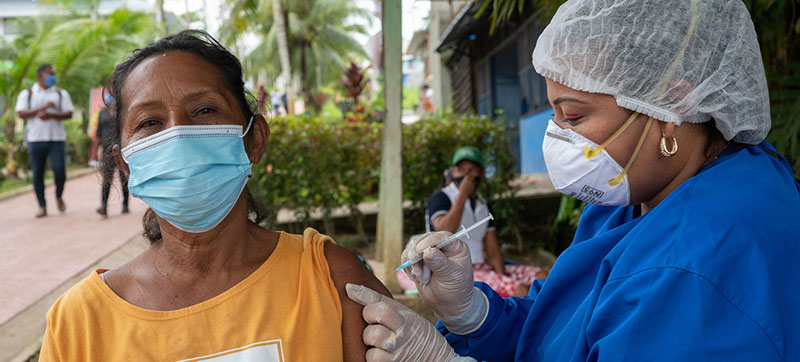
 Omicron
COVID-19: Don’t underestimate Omicron, WHO chief warns
New York: The Omicron variant is “probably” now present in most of the world’s countries and it would be a mistake to dismiss the COVID-19 strain as “mild”, said the head of the UN health agency (WHO) on Tuesday.
Tedros Adhanom Ghebreyesus, Director-General of the World Health Organization, told reporters from WHO headquarters in Geneva that the variant was now present in 77 countries.
Omicron is spreading at a rate we have not seen with any previous variant. We’re concerned that people are dismissing Omicron as mild”, he said. “Surely, we have learned by now that we underestimate this virus at our peril.”
“Even if Omicron does cause less severe disease, the sheer number of cases could once again overwhelm unprepared health systems. I need to be very clear: vaccines alone will not get any country out of this crisis. Countries can – and must – prevent the spread of Omicron with measures that work today.”
‘Do it all’
The United Kingdom’s top health adviser warned on Tuesday that Omicron infections could reach one million per day there, by the end of this month, adding that the National Health Service would face significant pressure if only a fraction of those newly infected need to be hospitalized – a troubling scenario in a country where some 70 per cent of the population are fully vaccinated.
Tedros warned that making choices about strategies to halt the pandemic, was the wrong approach: “It’s not vaccines instead of distancing. It’s not vaccines instead of ventilation or hand hygiene. Do it all. Do it consistently. Do it well.”
He said in the past 10 weeks, the international vaccine rollout initiative, COVAX, has shipped more vaccines than in the first 9 months of the year combined, with most countries using vaccines as fast as they get them.
“A small group of countries are facing challenges rolling out vaccines and scaling up rapidly, and WHO and our partners are working closely with those countries to overcome bottlenecks”, he added.
“Although we expect further improvements in supply, there are no guarantees, and the hard-won gains we have made are fragile.”
Boosters, for some
Tedros said “evolving evidence suggests a small decline in the effectiveness of vaccines against severe disease and death”, noting that booster rollouts for all over-18s to fight Omicron in some countries, had begun despite a lack of evidence that they will be effective.
“WHO is concerned that such programmes will repeat the vaccine hoarding we saw this year, and exacerbate inequity…Let me be very clear: WHO is not against boosters. We’re against inequity. Our main concern is to save lives, everywhere.”
The WHO chief said that giving boosters to groups at low risk, simply endangers the lives of those facing higher risk, who have not yet got their primary doses, due to supply constraints.
On the other hand, giving additional doses to people at high risk can save more lives than giving primary doses to those at low risk, he reasoned.
Prioritize the most vulnerable
“Together, we will save the most lives by making sure health workers, older people and other at-risk groups receive their primary doses of vaccines.
“In most countries, those being hospitalized and dying are those who have not been vaccinated. So, the priority must be to vaccinate the unvaccinated, even in countries with most access to vaccines.”
He said the priority in every country, for the sake of the global effort to halt the pandemic, “must be to protect the least protected, not the most protected.”
Some 41 countries have still not been able to vaccinate even 10% of their populations, and 98 countries have not yet reached 40%.
“If we end inequity, we end the pandemic”, he emphasised. “If we allow inequity to continue, we allow the pandemic to continue.”
Support Our Journalism
We cannot do without you.. your contribution supports unbiased journalism
IBNS is not driven by any ism- not wokeism, not racism, not skewed secularism, not hyper right-wing or left liberal ideals, nor by any hardline religious beliefs or hyper nationalism. We want to serve you good old objective news, as they are. We do not judge or preach. We let people decide for themselves. We only try to present factual and well-sourced news.
Support objective journalism for a small contribution.


