


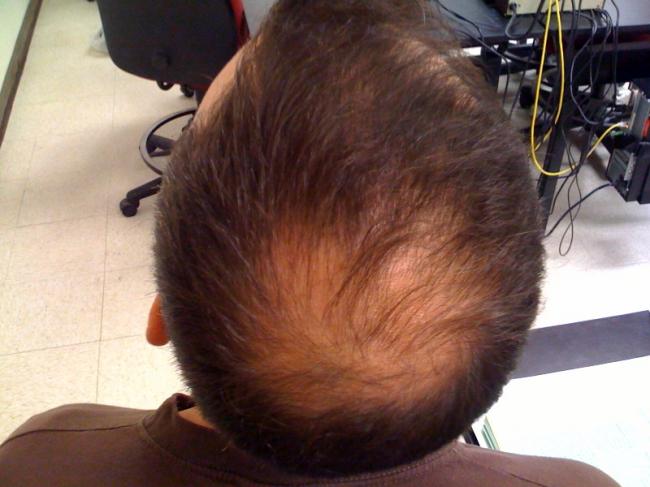
Drug side effects could treat human hair loss: Study
Manchester, May 9 (IBNS): A new drug could ease the distress of men and women who suffer from baldness, according to researchers from The University of Manchester’s Centre for Dermatology Research.
The study from the laboratory of Prof Ralf Paus, is published today (8 May) in the open access journal PLOS Biology
It shows that a drug originally designed as a treatment for osteoporosis has a dramatic stimulatory effect on human hair follicles donated by patients undergoing hair transplantation surgery.
Currently only two drugs – minoxidil and finasteride – are available for treatment of male-pattern balding (androgenetic alopecia),read the University of Manchester website.
However, both agents have moderate side effects and often produce disappointing hair regrowth results. The only other option available to patients is hair transplantation surgery.
The PhD project, led by Dr Nathan Hawkshaw and colleagues, sought to develop new ways to promote human hair growth with the hope of finding novel, well-tolerated agents for treating androgenetic alopecia.
The approach was to first identify the molecular mechanisms of an old immunosuppressive drug, Cyclosporine A (CsA).
Cyclosporine A has been commonly used since the 1980s as a crucial drug that suppresses transplant rejection and autoimmune diseases.
However, it often has severe side-effects, the least serious – but most interesting – of which is that it enhances cosmetically unwanted hair growth.
The team carried out a full gene expression analysis of isolated human scalp hair follicles treated with CsA. This revealed that CsA reduces the expression of SFRP1, a protein that inhibits the development and growth of many tissues, including hair follicles.
This identifies a completely novel mechanism of action of this old and widely used immunosuppressant.
The research also explanains why CsA so often induces undesired hair growth in patients as it removes an inbuilt and potent molecular brake on human hair growth.
The inhibitory mechanism is completely unrelated to CsA’s immunosuppressive activities, making SFRP1 a new and highly promising therapeutic target for anti-hair loss strategies.
After some detective work, Dr Hawkshaw found that a compound originally developed to treat osteoporosis, called WAY-316606, targets the same mechanism as CsA by specifically antagonising SFRP1.
When he then treated hair follicles with WAY-316606, the unrelated agent also effectively enhanced human hair growth like CsA.
The external application of WAY-316606 or similar compounds to balding human scalp, he argued, may promote hair growth to the same magnitude as CsA or even better, but without its side effects.
Dr Hawkshaw said: “Thanks to our collaboration with a local hair transplant surgeon, Dr Asim Shahmalak, we were able to conduct our experiments with scalp hair follicles that had generously been donated by over 40 patients and were then tested in organ cultures."
“This makes our research clinically very relevant, as many hair research studies only use cell culture.”
He added: “When the hair growth-promoting effects of CsA were previously studied in mice, a very different molecular mechanism of action was suggested; had we relied on these mouse research concepts, we would have been barking up the wrong tree.
“The fact this new agent, which had never even been considered in a hair loss context, promotes human hair growth is exciting because of its translational potential: it could one day make a real difference to people who suffer from hair loss.
“Clearly though, a clinical trial is required next to tell us whether this drug or similar compounds are both effective and safe in hair loss patients.”
Image: Wikimedia Commons
Support Our Journalism
We cannot do without you.. your contribution supports unbiased journalism
IBNS is not driven by any ism- not wokeism, not racism, not skewed secularism, not hyper right-wing or left liberal ideals, nor by any hardline religious beliefs or hyper nationalism. We want to serve you good old objective news, as they are. We do not judge or preach. We let people decide for themselves. We only try to present factual and well-sourced news.
Support objective journalism for a small contribution.


