


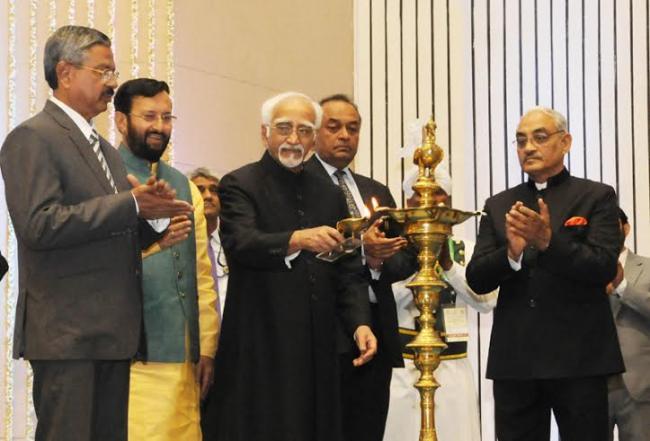
Environment degradation pose threat to human civilization: VP
The protection and preservation of environment and its sustainable management are essential for the survival of humanity and our planet.
Delivering inaugural address at the International Conference on ‘Global Environment Issues’ organised by the National Green Tribunal in association with the Ministry of Environment, Forests & Climate Change, Government of India here on Saturday, he said that environment is a public good.
"It is not owned by any one individual. Human activities result in significant environmental changes that cause damage to species, ecosystems and ecological processes. Preservation of the integrity of these ecological components is critical, considering they provide the bio-physical base necessary for human life, such as water, land, air, forests, biodiversity," said he.
He expressed his concern that the threat of climate change is a serious global concern.
"There is near consensus among scientists that climate change is unequivocal. Increase in anthropogenic activities has built up concentration of Greenhouse Gases in our atmosphere, leading to global warming. This in turn, could lead to changes in rainfall patterns, disruption in hydrological cycles, melting of ice caps and glaciers, rise in sea levels, and increase in frequency and intensity of extreme events such as heavy precipitation or cyclones. These developments can have a serious impact on sustainability of water resources, agriculture, forests and ecosystems, affecting the well-being of billions of people," Ansari said.
The Vice President opined that Sustainability of economic development crucially hinges on the protection of environment.
"For us in India, challenges of arresting the pace of degradation of environment are formidable due to the imperatives of maintaining high economic growth, increasing trends of urbanisation, population growth, industrialisation, unmet basic needs, life style changes and biotic pressures. We, therefore, need to pay greater attention to management of all natural resources through appropriate eco-friendly policies, regulatory frameworks, pricing of natural resources and making pollution costlier for the polluter," said he.
He said that in India, protecting and improving the natural environment is a fundamental duty of every citizen as per the Constitution.
"Domestic policies have been tailored to take into account the environmental impact assessments. Institutions to implement and monitor these policies have been set up at the centre and state level. India has also been active in international forums relating to environmental protection, and is party to 94 multilaterals environmental agreements. However, much more needs to be done to translate commitments into action and results," the VP noted.
The Vice President said that globally, India’s policy goal of achieving sustainable development and addressing emerging global environmental concerns, such as, climate change, ozone depletion and bio-dieversity loss, is guided by the principle of ‘common but differentiated responsibility’.
"India prefers an ‘aspirational’ rather than a mandatory or ‘prescriptive’ approach. We believe that the issue of sustainable development should be approached with a sense of equity; and the development aspirations of the developing countries should be built into the green economy principles being evolved at the international level. Whatever our respective national positions on these issues, the protection and preservation of environment is the common responsibility of all humanity. This calls for closer cooperation among nations and a holistic approach. Failure to do so would have serious consequences for our very survival as a species," he said.
Support Our Journalism
We cannot do without you.. your contribution supports unbiased journalism
IBNS is not driven by any ism- not wokeism, not racism, not skewed secularism, not hyper right-wing or left liberal ideals, nor by any hardline religious beliefs or hyper nationalism. We want to serve you good old objective news, as they are. We do not judge or preach. We let people decide for themselves. We only try to present factual and well-sourced news.
Support objective journalism for a small contribution.


