


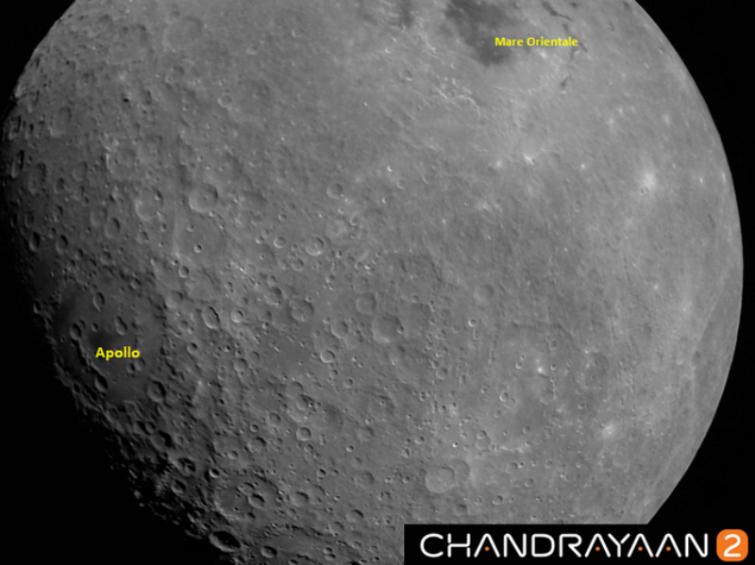
First image of moon by Chandrayaan-2 appears with Apollo craters and Mare Orientale basin
Chennai, Aug 22 (IBNS): The Indian Space Research Organisation (ISRO) on Thursday shared the first image of the moon captured by the Chandryaan-2 after its successful injection into the Lunar surface.
The ISRO also identified the Mare Orientale basin and Apollo craters in the picture.
The image of the moon was captured at a height of about 2,650 km from the Earth's natural satellite's surface.
The image was captured on Wednesday itself.
In a tweet, the ISRO posted: "Take a look at the first Moon image captured by #Chandrayaan2 #VikramLander taken at a height of about 2650 km from Lunar surface on August 21, 2019. Mare Orientale basin and Apollo craters are identified in the picture.
#ISRO"
Take a look at the first Moon image captured by #Chandrayaan2 #VikramLander taken at a height of about 2650 km from Lunar surface on August 21, 2019.
— ISRO (@isro) August 22, 2019
Mare Orientale basin and Apollo craters are identified in the picture.#ISRO pic.twitter.com/ZEoLnSlATQ
The Apollo crater, which is 538 km-wide, was named after NASA's Apollo moon missions.
It is located on the moon's southern hemisphere. According to NASA, many smaller craters are located inside the Apollo and are named after dead NASA astronauts and officials.
The Mare Orientale is claimed to be over 3 billion years old and about 950 km wide.
According to NASA, it is shaped like a bullseye and was formed after an impact from an asteroid-shaped object.
With the insertion of Chandrayaan-2 into the lunar orbit, the spacecraft began its challenging journey for a soft landing on the moon's South Polar region, hitherto an unexplored frontier by any country in the world so far.
After the successful launch, Chandrayaan-2, carrying an Orbiter, Lander (Vikram) and six-wheeled robotic Rover (Pragyan), commenced its 3.844 lakh km, 48-day long journey for a soft landing on the Moon's South Pole.
Weighing 3,850 kg, Chandrayaan-2 was carrying 13 Indian Payloads (eight on Orbiter, 3 on Lander and two on Rover) and one passive experiment from NASA.
While the technical difficulties of landing on the Moon's South Polar region have deterred many previous attempts, Chandrayaan-2 will be the first to reach this part of the lunar surface- taking the Indian Tri-colour where no human has been before.
Support Our Journalism
We cannot do without you.. your contribution supports unbiased journalism
IBNS is not driven by any ism- not wokeism, not racism, not skewed secularism, not hyper right-wing or left liberal ideals, nor by any hardline religious beliefs or hyper nationalism. We want to serve you good old objective news, as they are. We do not judge or preach. We let people decide for themselves. We only try to present factual and well-sourced news.
Support objective journalism for a small contribution.


