


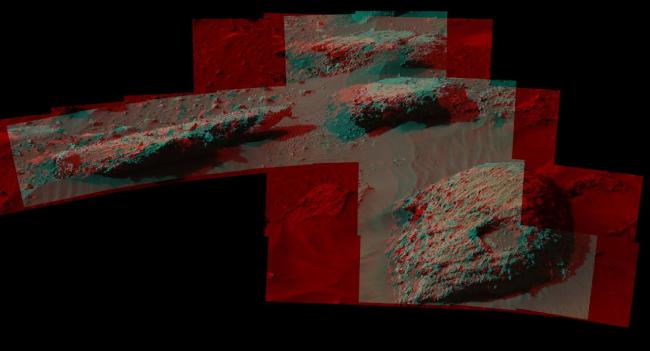
Full-Circle Vista from NASA Mars Rover Curiosity shows 'Murray Buttes'
The rover used its Mast Camera (Mastcam) to capture dozens of component images of this scene on Aug. 5, 2016, four years after Curiosity's landing inside Gale Crater, read the NASA website.
The visual drama of Murray Buttes along Curiosity's planned route up lower Mount Sharp was anticipated when the site was informally named nearly three years ago to honor Caltech planetary scientist Bruce Murray (1931-2013), a former director of NASA's Jet Propulsion Laboratory, Pasadena, California. JPL manages the Curiosity mission for NASA.
The buttes and mesas are capped with rock that is relatively resistant to wind erosion.
This helps preserve these monumental remnants of a layer that formerly more fully covered the underlying layer that the rover is now driving on.
Early in its mission on Mars, Curiosity accomplished its main goal when it found and examined an ancient habitable environment.
In an extended mission, the rover is examining successively younger layers as it climbs the lower part of Mount Sharp.
A key goal is to learn how freshwater lake conditions, which would have been favorable for microbes billions of years ago if Mars has ever had life, evolved into harsher, arid conditions much less suited to supporting life.
The mission is also monitoring the modern environment of Mars.
These findings have been addressing high-priority goals for planetary science and further aid NASA’s preparations for a human mission to the Red Planet.
Credits: NASA/JPL-Caltech
Support Our Journalism
We cannot do without you.. your contribution supports unbiased journalism
IBNS is not driven by any ism- not wokeism, not racism, not skewed secularism, not hyper right-wing or left liberal ideals, nor by any hardline religious beliefs or hyper nationalism. We want to serve you good old objective news, as they are. We do not judge or preach. We let people decide for themselves. We only try to present factual and well-sourced news.
Support objective journalism for a small contribution.


