


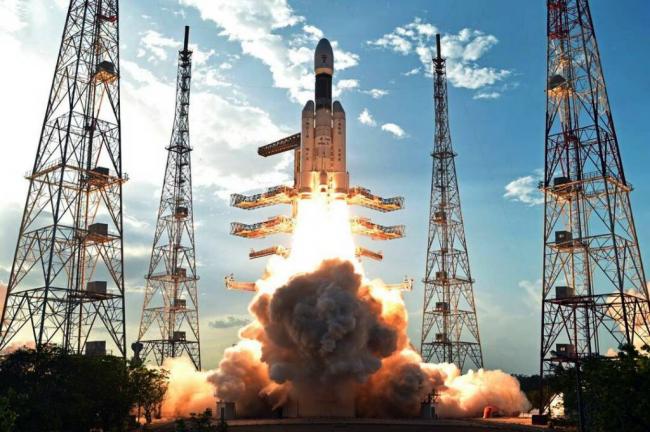
GSLV MkIII Successfully launches GSAT-19 Satellite
This was the first orbital mission of GSLV MkIII which was mainly intended to evaluate the vehicle performance including that of its fully indigenous cryogenic upper stage during the flight.
Weighing 3136 kg at lift-off, GSAT-19 is the heaviest satellite launched from the Indian soil.
"After a twenty five and a half hour smooth countdown, the mission began with the launch of the 640 ton GSLV Mk-III at 5:28 pm IST from the Second
Launch Pad as scheduled with the ignition of its two S200 solid strap-on boosters. Following this, the major phases of the flight occurred as
scheduled. The upper stage of GSLV MkIII vehicle is a new cryogenic stage (C25) indigenously configured, designed and realised by ISRO," read the statement issued by ISRO.
The cryogenic stage used liquid Hydrogen and liquid Oxygen as propellants with a total loading of 28 tons.
The stage is powered by a 20 ton thrust cryogenic engine (CE20) operating on ‘gas generator cycle’.
The performance of the engine and stage during the mission was as predicted. About sixteen minutes after lift-off, GSAT-19 satellite was successfully placed in orbit.
Soon after its separation from GSLV, the Master Control Facility (MCF) at Hassan in Karnataka assumed control of the satellite. GSAT-19 is a high throughput communication satellite.
In the coming days, GSAT-19 orbit will be raised from its present Geosynchronous Transfer Orbit (GTO) to the final circular Geostationary Orbit (GSO) by firing the satellite's Liquid Apogee Motor (LAM) in stages.
During the final phase of this operation, the solar panels and antenna reflectors of the satellite will be deployed.
The satellite will be commissioned into service after its positioning in the designated slot in the GSO following in-orbit testing of its payloads.
Support Our Journalism
We cannot do without you.. your contribution supports unbiased journalism
IBNS is not driven by any ism- not wokeism, not racism, not skewed secularism, not hyper right-wing or left liberal ideals, nor by any hardline religious beliefs or hyper nationalism. We want to serve you good old objective news, as they are. We do not judge or preach. We let people decide for themselves. We only try to present factual and well-sourced news.
Support objective journalism for a small contribution.


