


HIV/AIDS still impacting work and costing billions in lost earnings – new UN agency report
New York, May 25 (IBNS): Outlining the economic and social toll HIV and AIDS continues to take on workers around the world, the International Labour Organization (ILO) called on Thursday for an “urgent effort” to improve treatment, step up testing and ensure healthier and more productive workplaces.
Prepared in collaboration with the UN agency dedicated to tackling the virus, UNAIDS, The impact of HIV and AIDS on the world of work: Global estimate, examines the past and future effects of HIV epidemic, and development of antiretroviral therapy (ART), while assessing the economic and social impact on workers and their households.
The report shows that workers’ deaths attributed to HIV and AIDS are projected to fall to 425,000 worldwide in 2020, from 1.3 million in 2005; with people in their late-30s the most affected.
“This is the age workers are normally at the peak of their productive life,” said Guy Ryder, ILO Director-General.
“These deaths are totally avoidable if treatment is scaled up and fast-tracked,” he added.
In addition to the toll on lives, the report indicates that the disease costs billions of dollars in lost earnings – largely due to the hundreds of thousands of preventable HIV- and AIDS-related deaths.
Although the lost earnings have decline substantially from almost $17 billion in 2005, they are still projected to amount to $7.2 billion in 2020.
The good news is that ART is keeping employees healthy and productive, causing the number of workers living with HIV, either fully or partially unable to work, to drop dramatically since 2005.
The total number of those estimated to be fully unable to work is expected to decline to about 40,000 in 2020 from a 2005 level of about 350,000 – an 85 per cent decline for men and a 93 per cent drop for women.
The report recommended that treatment be scaled up and stressed the need to produce better integrated health data with social and economic components to capture the full impact of AIDS-related diseases.
The Impact of HIV also looked at “hidden costs,” such as those being exacted on household members.
It predicts that in 2020, some 140,000 children will carry what ILO refers to as the “child-labour level chore burden”, while an additional full-time equivalent of 50,000 workers will perform unpaid care work.
It also shows that the number of workers living with HIV increased from 22.5 million in 2005 to 26.6 million in 2015 and is projected to rise to some 30 million in 2020, even if ART is scaled up.
“Mere scaling up of treatment is not enough,” stressed Ryder.
“Testing and HIV prevention measures also need to be stepped up if we are going to end AIDS. This makes human sense. And this makes astute economic sense,” he concluded.
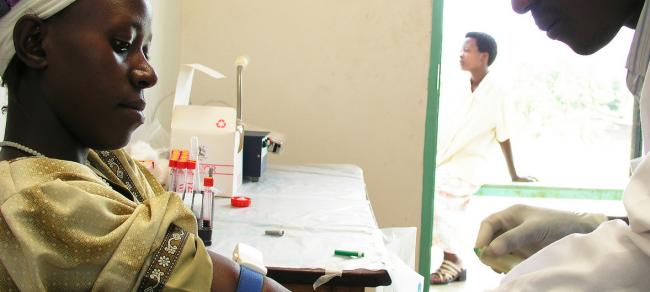
World Bank/Arne Hoel
Support Our Journalism
We cannot do without you.. your contribution supports unbiased journalism
IBNS is not driven by any ism- not wokeism, not racism, not skewed secularism, not hyper right-wing or left liberal ideals, nor by any hardline religious beliefs or hyper nationalism. We want to serve you good old objective news, as they are. We do not judge or preach. We let people decide for themselves. We only try to present factual and well-sourced news.
Support objective journalism for a small contribution.


