


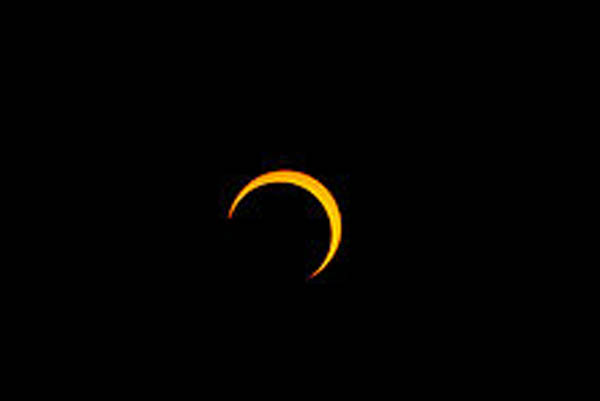
How did the 2015 Solar Eclipse affect temperatures, finds study
The research showed the eclipse on the Mar 20, 2015 resulted in a drop in land surface temperatures in parts of the UK and Europe, read the .
This, combined with a study of one-minute observations of near-surface air temperature from meteorological stations in the UK, has allowed scientists to build a picture of the factors that influence how the surface temperature changes during a solar eclipse.
A solar eclipse provides a unique opportunity to observe how the Earth-system reacts to abrupt changes in solar activity.
The results from the satellite analysis show that the amount of sun obscured by the moon, the eclipse duration and the timing, all influence the temperature drop during the event.
The largest temperature drops occurred where the sun was most obscured, the eclipse was longer, or the timing was earlier in the day.
The analysis of near-surface air temperatures from UK stations showed that the temperature decreases were four times larger, on average at sites with clear skies than at cloudy sites, with the biggest anomaly occurring at a coastal location where flow moved from onshore to offshore during the eclipse.
Two papers, written by Met Office scientists Dr Elizabeth Good and Matt Clark, entitled 'Satellite observations of surface temperature during the March 2015 total solar eclipse' and 'The variability of near-surface screen temperature anomalies in the 20 March 2015 solar eclipse', are to be published in a special solar eclipse edition of the Royal Society's Philosophical Transactions A.
Dr Elizabeth Good, Research Scientist: Climate Monitoring and Attribution Team, said; "Local factors, such as vegetation cover, land use and cloud cover has resulted in previous studies struggling to find links between temperature and the obscuration of the sun however the use of satellite data from across a large area has allowed for this to be investigated using observed data for the first time."
The aim of the research was to increase our understanding of the behaviour of surface temperatures over Europe during a solar eclipse.
The March 2015 eclipse was total across the North Atlantic, the Faroe Islands and Svalbard, and partial in Europe, Iceland, parts of North Africa and northern Asia.
For most of Europe, the eclipse was a morning event, with mid-eclipse occurring at a local solar time of between about 08:00 in the west and 14:30 in the east.
Image: Wikimedia Commons
Support Our Journalism
We cannot do without you.. your contribution supports unbiased journalism
IBNS is not driven by any ism- not wokeism, not racism, not skewed secularism, not hyper right-wing or left liberal ideals, nor by any hardline religious beliefs or hyper nationalism. We want to serve you good old objective news, as they are. We do not judge or preach. We let people decide for themselves. We only try to present factual and well-sourced news.
Support objective journalism for a small contribution.


