July 08, 2026 11:52 pm (IST)

Follow us:


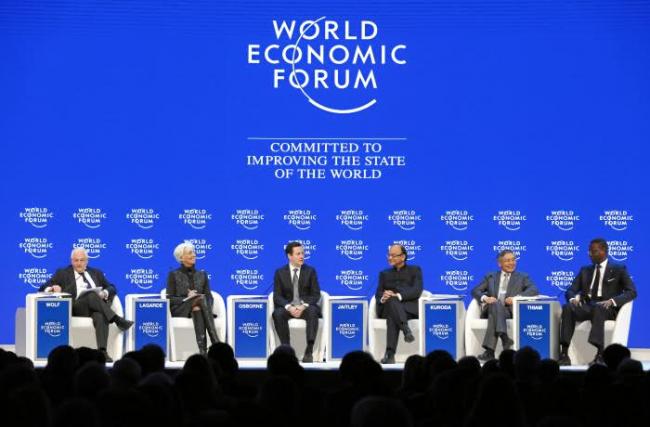
Improving outlook for science depends on basic research, better use of talent: Leaders at WEF
Davos-Klosters, Switzerland, Jan 24 (Just Earth News/IBNS): As the world surges into the Fourth Industrial Revolution- a new age of interactive technologies, artificial intelligence and automation-a key challenge for individuals will be to understand and retain their very essence, their humanity, leading scientists and thought leaders on society and law said in the closing panel session of the World Economic Forum Annual Meeting 2016.
Being able to master the technologies of the Fourth Industrial Revolution must be an essential part of that, the panellists agreed.
Said Henry T. Greely, the Deane F. and Kate Edelman Johnson Professor of Law at Stanford University in the US: “All of us need to begin to understand and grapple with how we want to shape these technologies.”
“We are competing with artificial intelligence,” asserted Meeting Co-Chair Amira Yahyaoui, Founder and Chair of citizens action group Al Bawsala in Tunisia and a member of the World Economic Forum’s Global Shaper community of leaders in their twenties. “We really have to show we are the good ones. So the discussion of ethics and value has never been more essential than it is today.” Justine Cassell, Associate Dean, Technology, Strategy and Impact, in the School of Computer Science at Carnegie Mellon University in the US, countered: “I don’t think of robots as competitors. I think of them as collaborators to help us do what we wish to do but can’t do alone and help us to be part of a larger community.”
Robots and artificial intelligence will force people to hone human skills that were much more important generations ago in the days of very low tech. “Empathy, respect – those skills will be effective for the workplace of the future,” Cassell reckoned. “It is through comparison with robots that we will know what it is to be human.”
“We are the wine and not the bottles,” Greely stressed. “I have a metal hip but it hasn’t made me less human. What makes us human is not the body but what is inside us.” Jennifer Doudna, Professor of Chemistry and of Molecular and Cell Biology at the University of California, Berkeley, in the United States, added: “I am a scientist and I feel that what makes us human comes from our brain chemistry. We are not about our physical bodies but what is going on in our brains.”
Genetics plays a part, Greely acknowledged. Being human entails “a learned set of responses to things,” he explained. “There is some genetic basis for altruism, ambition or compassion, but how to get that expressed depends on how we are taught. Being human is not a thing; it is a process. The way to make sure that we are human is to have teachers who teach us how to be human. If a robot internalized the same kind of human reactions that we have, I would call him or it a fellow human.”
Support Our Journalism
We cannot do without you.. your contribution supports unbiased journalism
IBNS is not driven by any ism- not wokeism, not racism, not skewed secularism, not hyper right-wing or left liberal ideals, nor by any hardline religious beliefs or hyper nationalism. We want to serve you good old objective news, as they are. We do not judge or preach. We let people decide for themselves. We only try to present factual and well-sourced news.
Support objective journalism for a small contribution.


Latest Headlines
Breakthrough alert: Indians scientists develop ultra-efficient thermal battery for clean energy storage
Fri, May 22 2026
You may not live 50 years: Nobel winner David Gross issues stark nuclear war warning
Tue, Apr 21 2026
Dear NASA…”: 10-year-old’s heartfelt plea to bring Pluto back as a planet goes viral
Sat, Apr 11 2026
AI Robot replaces humans in dangerous canal cleaning in Thiruvananthapuram — Here’s how G-SPIDER works
Fri, Mar 06 2026
NASA Hubble captures stunning image of Wolf-Rayet Star Hen 2-427, surrounding nebula M1-67
Fri, Feb 13 2026
India’s space boom: 399 Start-ups, $8.4 billion economy and counting, says Minister
Fri, Jan 30 2026
Moon hotel is coming: Space tourists can book a stay for $1 million
Tue, Jan 20 2026