


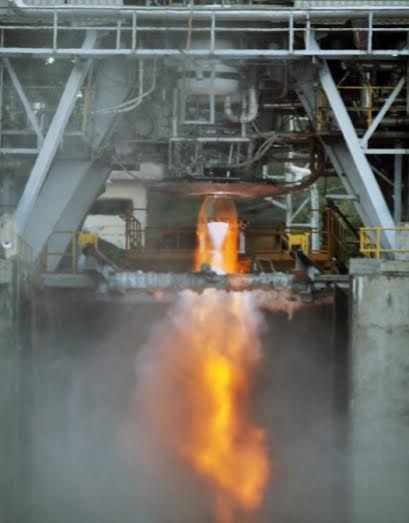
ISRO scientists test India's most powerful Cryogenic Engine
This duration is approximately 25% more than the engine burn duration in flight.
The engine will be used for powering the Cryogenic stage (C25), the upper stage of the next generation GSLV Mk-III launch vehicle of ISRO, capable of launching four tonne class satellites.
This cryogenic engine of C25 Stage operates on Gas Generator Cycle using extremely low temperature propellants – Liquid Hydrogen (LH2) at 20 Kelvin (-253 deg C) and Liquid Oxygen (LOX) at 80K (-193deg C). The various subsystems of the engine are – regeneratively cooled Thrust Chamber, Gas Generator, LOX and LH2 high speed turbopump systems, flow control components, close loop mixture ratio control system, Pyrogen igniters, fluid systems, etc.
The turbopump system rotates at a speed of 36,000 rpm with a power level of 2 MW.
This high performance cryogenic engine was conceived, configured and realised by Liquid Propulsion Systems Centre (LPSC), the lead centre of Indian Space Research Organisation (ISRO) responsible for developing liquid propulsion systems for Indian Space Programme.
The Engine design was totally in-house effort with experts from different fields like fluid dynamics, combustion, thermal, structural, metallurgy, fabrication, rotor dynamics, control components, etc., working together.
The fabrication of major subsystems of the engine was carried out through Indian Industries. Assembly and Integration of the engine and Testing were carried out in ISRO Propulsion Complex (IPRC), a unit of ISRO.
LPSC has also developed a cryogenic upper stage of 12.5 tonne propellant loading and successfully flight tested it in GSLV Mk-II vehicle on January 5, 2014. Compared to this stage, the C25 stage has a higher propellant loading (27 tonnes versus 12.5 tonnes) and higher engine thrust (19 tonne versus 7.5 tonne).
The recent successful endurance hot test of the first high thrust cryogenic engine is the tenth test in a series of tests planned and executed as part of the development of the engine employing complex cryogenic technology.
The performance of the engine closely matches with the pre-test prediction made using the in-house developed cryogenic engine mathematical modelling and simulation software.
Prior to engine realisation, a series of subsystem level tests were carried out to independently evaluate the design of major subsystems like the turbopumps, thrust chamber, gas generator, flow control components, etc. Based on the confidence gained, the integrated engine testing was initiated.
As part of the C25 Stage development, further tests are planned in High Altitude conditions and in Stage configuration, prior to the flight stage realisation.
Mastering this complex, high performance cryogenic propulsion technology will go a long way in building self reliance for the Indian Space Programme.
Support Our Journalism
We cannot do without you.. your contribution supports unbiased journalism
IBNS is not driven by any ism- not wokeism, not racism, not skewed secularism, not hyper right-wing or left liberal ideals, nor by any hardline religious beliefs or hyper nationalism. We want to serve you good old objective news, as they are. We do not judge or preach. We let people decide for themselves. We only try to present factual and well-sourced news.
Support objective journalism for a small contribution.


