


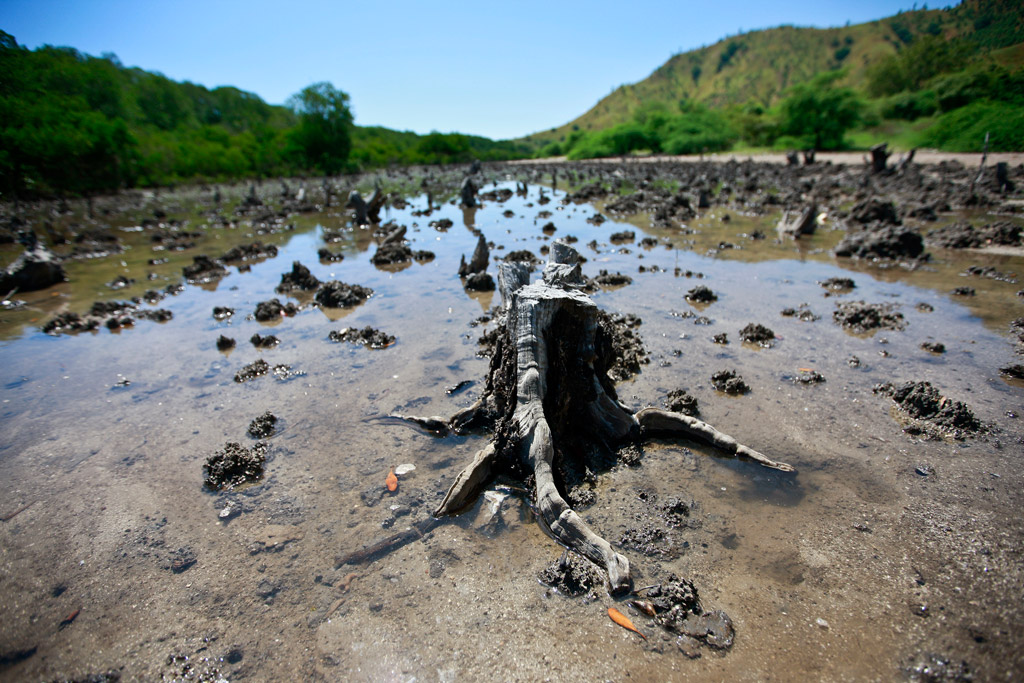
New UN report warns of 'devastating' effects from ongoing destruction of mangrove forests
In a new report launched on Monday at the 16th Global Meeting of the Regional Seas Conventions and Action Plans, held in Athens, Greece, the UN Environment Programme (UNEP) warnedthat the deforestation of the planet’s mangroves was exceeding average global forest loss by a rate of three to five times, resulting in economic damages of up to $42 billion annually and exposing ecosystems and coastal habitats to an increased risk of devastation from climate change.
“The escalating destruction and degradation of mangroves – driven by land conversion for aquaculture and agriculture, coastal development, and pollution – is occurring at an alarming rate, with over a quarter of the earth’s original mangrove cover now lost,” said UNEP Executive Director Achim Steiner.
“This has potentially devastating effects on biodiversity, food security and the livelihoods of some of the most marginalized coastal communities in developing countries, where more than 90 per cent of the world’s mangroves are found,” he added.
The Executive Director noted that mangroves – which are found in 123 countries around the world – provide ecosystem services worth up to $57,000 per hectare per year, storing carbon that would otherwise be released into the atmosphere and providing the over 100 million people who live in their vicinity with a variety of goods and services such as fisheries and forest products, clean water and protection against erosion and extreme weather events.
Steiner stressed that their continued destruction “makes neither ecological nor economic sense.”
In addition to the economic problems posed by mangrove deforestation, the report, entitled The Importance of Mangroves: A Call to Action, also cautions that a continued reduction in the surface area of mangrove forests would inevitably expose coastal environments to the harmful effects of climate change.
In the Caribbean, for instance, mangrove-lined “hurricane holes” have functioned for centuries as safe-havens for boaters needing to ride out stor Meanwhile, the complex network of mangrove roots can help reduce wave energy, limit erosion and form a critical barrier to the dangers posed by the strengthening tropical storms, cyclones and tsunamis which have been assailing coastal communities in recent years due to climate change.
In order to safeguard what UNEP calls “one of the most threatened ecosystems on the planet,” the report outlines a number of financial mechanisms and incentives designed to stimulate conservation, including the creation of a Global Mangrove Fund, encouraging mangrove conservation and restoration through carbon credit markets, and promoting economic incentives as a source of local income from mangrove protection, sustainable use, and restoration activities.
Steiner admitted that it was important to present the survival of mangroves in real terms, underlining the economic impact their destruction would have on the local and global communities and pushing for greater international concern for their overall preservation.
“By quantifying in economic terms the value of the ecosystem services provided by mangroves as well as the critical role they play in global climate regulation, the report aims to encourage policymakers to use the tools and guidelines outlined to better ensure the conservation and sustainable management of mangroves.”
Image: UN Photo/Martine Perret
Support Our Journalism
We cannot do without you.. your contribution supports unbiased journalism
IBNS is not driven by any ism- not wokeism, not racism, not skewed secularism, not hyper right-wing or left liberal ideals, nor by any hardline religious beliefs or hyper nationalism. We want to serve you good old objective news, as they are. We do not judge or preach. We let people decide for themselves. We only try to present factual and well-sourced news.
Support objective journalism for a small contribution.


