


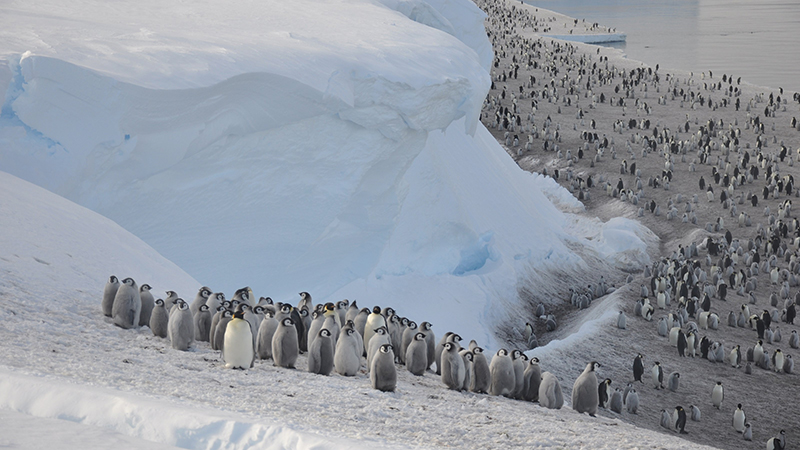
 Emperor Penguin
Scientists find four new previously unknown emperor penguin colonies from satellite images of Antarctica
Scientists from the British Antarctic Survey have discovered four previously unknown emperor penguin breeding sites.
Changing sea ice conditions along Antarctica’s coastline have forced several emperor colonies to move in search of more stable sea ice to breed on; some known colonies have already moved 30-40km to new breeding grounds.
Scientists searched for these new sites using satellites and, in the process, discovered colonies which had never been recorded before.
This includes the colony in Halley Bay which was previously thought to have vanished, which has re-established itself near the MacDonald Ice Rumples, 30km east of the old site, after the calving of the Brunt Ice Shelf.
With these new discoveries, and the re-establishment of Halley Bay, the total of known emperor penguin colonies now stands at 66.
Emperor penguin breeding sites are typically remote and inhospitable, so scientists use satellite imagery to discover and monitor emperor penguin colonies, as the brown stains of the birds’ brown guano stand out clearly against the stark white of ice and snow.
The team studied images from the European Commission’s Copernicus Sentinel-2 satellite mission, which were compared to and confirmed by high-resolution images from the Maxar WorldView-3 satellite.
Despite these findings, predictions of future emperor penguin populations are stark; earlier this year, British Antarctic Survey researchers reported catastrophic breeding failure of emperor penguins caused by sea ice loss.
Dr Peter Fretwell, who uses satellite imagery to monitor penguin populations at BAS says: “These newly identified locations fill in almost all the gaps in the known distribution of these iconic birds. All except one of these colonies are small with less than 1000 birds, so finding these new colonies makes little difference to the overall population size. In fact, it is overshadowed by the recently reported breeding failures due to the early and fast ice loss.”
Emperor penguins are dependent on stable sea ice that is firmly attached to the shore – known as ‘land-fast’ ice – for most of the year. Once they arrive at their chosen breeding site, penguin lay eggs in the Antarctic winter from May to June. Their eggs hatch after 65 days but chicks do not fledge until between December and January.
Since 2016, Antarctic has seen the four years with the lowest sea ice extents in the 45-year satellite record, with the two lowest years in 2021/22 and 2022/23. As of August 2023, the sea ice extent was 2.2 million km2 lower than the 1981 – 2022 median, equivalent to an area larger than Greenland.
Emperor penguins have previously responded to incidents of sea ice loss by moving to more stable sites the following year. However, this strategy doesn’t work if sea ice is affected across an entire region.
Support Our Journalism
We cannot do without you.. your contribution supports unbiased journalism
IBNS is not driven by any ism- not wokeism, not racism, not skewed secularism, not hyper right-wing or left liberal ideals, nor by any hardline religious beliefs or hyper nationalism. We want to serve you good old objective news, as they are. We do not judge or preach. We let people decide for themselves. We only try to present factual and well-sourced news.
Support objective journalism for a small contribution.


