


Scientists visualise quantum behaviour of hot electrons for first time
The findings present a promising step forward towards being able to manipulate and control the behaviour of high energy, or ‘hot’, electrons.
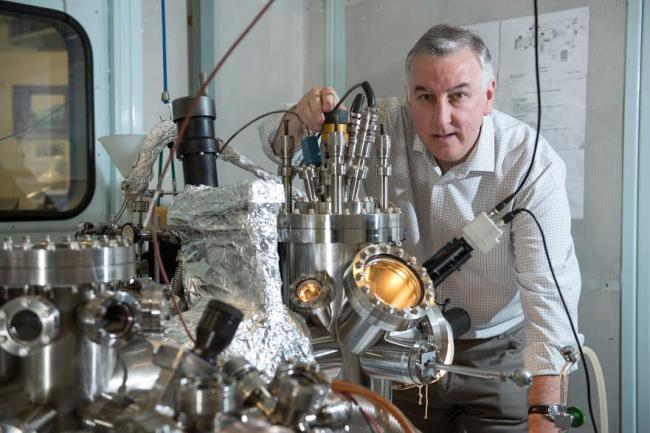
A Scanning Tunnelling Microscope was used to inject electrons into a silicon surface, decorated with toluene molecules. As the injected charge propagated from the tip, it induced the molecules to react and ‘lift off’ from the surface.
By measuring the precise atomic positions from which molecules departed on injection, the team were able to identify that electrons were governed by quantum mechanics close to the tip, and then by more classical behaviour further away.
The team found that the molecular lift-off was “suppressed” near the point of charge injection, because the classical behaviour was inhibited.
The number of reactions close to the tip increased rapidly until reaching a radius, up to 15 nanometres away, before seeing relatively slow decay of reactions beyond that point more in keeping with classical behaviour.
This radius, at which the behaviour changes from quantum to classical, could be altered by varying the energy of the electrons injected.
The research, published in Nature Communications, is the result of ongoing collaboration between the University of Birmingham and the University of Bath.
Professor Richard Palmer, from the University of Birmingham, explained: “When an electron is captured by a molecule of toluene, we see the molecule lift off from the surface – imagine the Apollo lander leaving the moon’s surface.
By comparing before and after images of the surface we measure the pattern of these molecular launch sites and reveal the behaviour of electrons in a manner not possible before.
“These findings are, crucially, undertaken at room temperature. They show that the quantum behaviour of electrons which is easily accessible at close to absolute zero temperature (-273°C!) persist under the more balmy conditions of room temperature and over a “large” 15 nanometre scale. These findings suggest future atomic-scale quantum devices could work without the need for a tank of liquid helium coolant.”
Dr Peter Sloan, from the University of Bath, added: “Hot electrons are essential for a number of processes – certain technologies are entirely reliant on them. But they’re notoriously difficult to observe due to their short lifespan, about a millionth of a billionth of a second. This visualisation technique gives us a really new level of understanding.”
Now that the team have developed the method of visualising quantum transport, the goal is to understand how to control and manipulate the wave function of the electron. This could be by injecting electrons through a cluster of metal atoms, or by manipulating the surfaces themselves to harness the quantum effects of electrons.
The implications of being able to manipulate the behaviour of hot electrons are far-reaching; from improving the efficiency of solar energy, to improving the targeting of radiotherapy for cancer treatment.
Support Our Journalism
We cannot do without you.. your contribution supports unbiased journalism
IBNS is not driven by any ism- not wokeism, not racism, not skewed secularism, not hyper right-wing or left liberal ideals, nor by any hardline religious beliefs or hyper nationalism. We want to serve you good old objective news, as they are. We do not judge or preach. We let people decide for themselves. We only try to present factual and well-sourced news.
Support objective journalism for a small contribution.


