


 Nobel Prize Physics
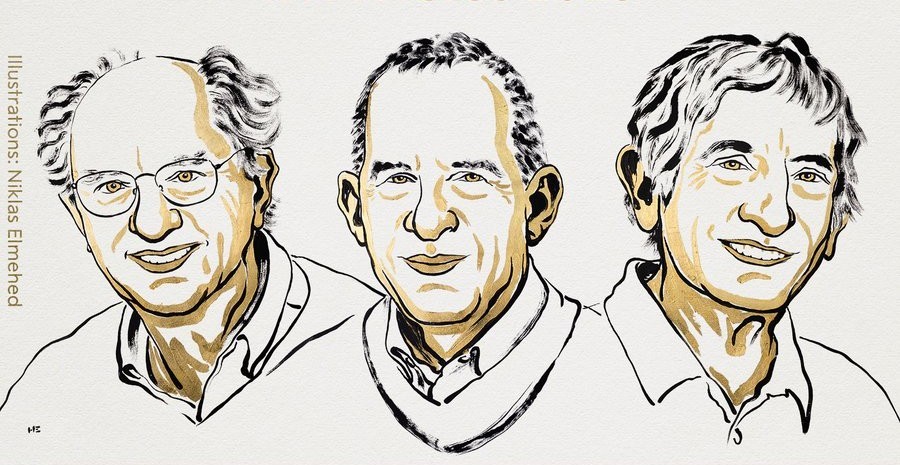
U.S.-based scientists John Clarke, Michel Devoret and John Martinis win Nobel Prize in Physics
U.S.-based scientists John Clarke, Michel Devoret and John Martinis have won the Nobel Prize in Physics for “the discovery of macroscopic quantum mechanical tunnelling and energy quantisation in an electric circuit", the award-giving body announced on Tuesday.
Quantum mechanics allows a particle to move straight through a barrier, using a process called tunnelling. As soon as large numbers of particles are involved, quantum mechanical effects usually become insignificant. The laureates’ experiments demonstrated that quantum mechanical properties can be made concrete on a macroscopic scale.
In 1984 and 1985, John Clarke, Michel H. Devoret and John M. Martinis conducted a series of experiments with an electronic circuit built of superconductors, components that can conduct a current with no electrical resistance.
In the circuit, the superconducting components were separated by a thin layer of non-conductive material, a setup known as a Josephson junction.
By refining and measuring all the various properties of their circuit, they were able to control and explore the phenomena that arose when they passed a current through it.
Together, the charged particles moving through the superconductor comprised a system that behaved as if they were a single particle that filled the entire circuit.
This macroscopic particle-like system is initially in a state in which current flows without any voltage.
The system is trapped in this state, as if behind a barrier that it cannot cross.
In the experiment the system shows its quantum character by managing to escape the zero-voltage state through tunnelling. The system’s changed state is detected through the appearance of a voltage.
The laureates could also demonstrate that the system behaves in the manner predicted by quantum mechanics – it is quantised, meaning that it only absorbs or emits specific amounts of energy.
“It is wonderful to be able to celebrate the way that century-old quantum mechanics continually offers new surprises. It is also enormously useful, as quantum mechanics is the foundation of all digital technology,” says Olle Eriksson, Chair of the Nobel Committee for Physics.
The transistors in computer microchips are one example of the established quantum technology that surrounds us.
This year’s Nobel Prize in Physics has provided opportunities for developing the next generation of quantum technology, including quantum cryptography, quantum computers, and quantum sensors.
Support Our Journalism
We cannot do without you.. your contribution supports unbiased journalism
IBNS is not driven by any ism- not wokeism, not racism, not skewed secularism, not hyper right-wing or left liberal ideals, nor by any hardline religious beliefs or hyper nationalism. We want to serve you good old objective news, as they are. We do not judge or preach. We let people decide for themselves. We only try to present factual and well-sourced news.
Support objective journalism for a small contribution.


