


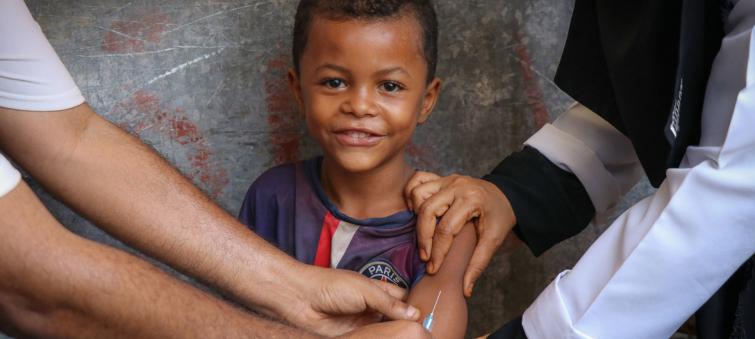
Vaccinations create ‘umbrella of immunity’ against global measles outbreaks, says UNICEF
New York, Apr 25 (IBNS): Between 2010 and 2017, an average of 21.1 million children missed their first dose of the measles vaccine, the United Nations Children’s Fund (UNICEF) revealed on Wednesday, stressing its importance to creating “an umbrella of immunity for everyone.”
According to UNICEF, widening pockets of unvaccinated children have created a pathway to the measles outbreaks currently spreading around the world.
“The ground for the global measles outbreaks we are witnessing today was laid years ago,” said Henrietta Fore, UNICEF Executive Director.
During the first three months of 2019, more than 110,000 measles cases were reported worldwide, representing a near 300 per cent jump from the same period last year. And in 2017, measles cost some 110,000 people, mostly children, their lives, representing a 22 per cent increase from the previous year.
UNICEF explained that although two doses of the measles vaccine are “essential” to protect children from the disease, a lack of access, poor health systems, complacency, and in some cases a fear of vaccines, led to a drop in global coverage to only 85 per cent in 2017, which has remained relatively constant over the last decade.
However, at 67 per cent, global coverage for the second dose is much lower. The World Health Organization (WHO) recommends a threshold of 95 per cent immunization coverage to achieve so-called “herd immunity”; or vaccinating a significant enough portion of the population to provide protection for those who have yet to develop immunity.
“The measles virus will always find unvaccinated children”, Ms. Fore stated, but “if we are serious about averting the spread of this dangerous but preventable disease, we need to vaccinate every child, in rich and poor countries alike.”
View by income
While 94 per cent of people in high-income countries receive the first dose, coverage for the second dips to 91 per cent, according to the latest data.
The United States tops the list of high-income countries not receiving the first dose of the vaccine (2.5 million children), followed by France (600,000) and the United Kingdom (500,000) during the period between 2010 and 2017.
In low- and middle-income countries, the situation is critical.
In 2017, for example, nearly four million Nigerian children under 12 months, missed out on the first dose, putting it in the number one spot, followed by India at 2.9 million, Pakistan and Indonesia each at 1.2 million each and Ethiopia at 1.1 million.
Worldwide coverage levels of the second dose are even worse. Of the 20 countries with the largest number of unvaccinated children in 2017, nine have not introduced the second dose.
In sub-Saharan Africa, 20 countries have not introduced the necessary second dose in the national vaccination schedule, putting over 17 million infants a year at higher risk of measles during their childhood.
“Measles is far too contagious,” Ms. Fore underscored. “It is critical not only to increase coverage but also to sustain vaccination rates at the right doses to create an umbrella of immunity for everyone,” she concluded.
Tackling the crisis
UNICEF, with partners such as the Measles and Rubella Initiative and Gavi, the Vaccine Alliance, is helping address this measles crisis by:
Negotiating vaccine prices.
Helping countries identify underserved areas and unreached children.
Procuring vaccines and other immunization supplies.
Supporting vaccination campaigns to address immunization coverage gaps.
Working to introduce the second measles dose vaccine in national immunization schedules.
Introducing solar power, mobile technologies and other innovations to maintain vaccine temperatures.
Support Our Journalism
We cannot do without you.. your contribution supports unbiased journalism
IBNS is not driven by any ism- not wokeism, not racism, not skewed secularism, not hyper right-wing or left liberal ideals, nor by any hardline religious beliefs or hyper nationalism. We want to serve you good old objective news, as they are. We do not judge or preach. We let people decide for themselves. We only try to present factual and well-sourced news.
Support objective journalism for a small contribution.


