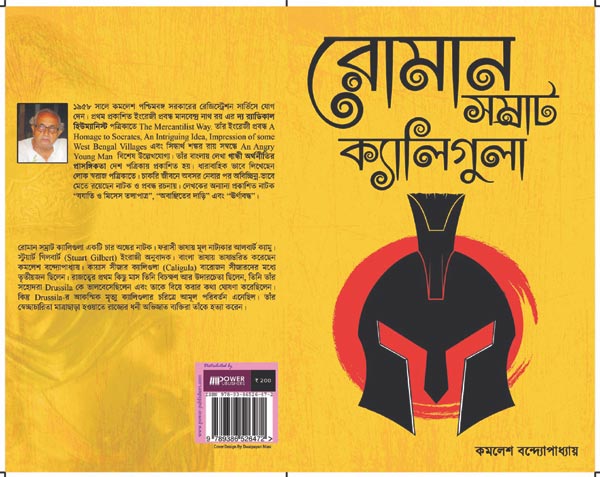
Albert Camus' drama Caligula in translation
This drama is about a young Roman emperor, Caligula, who is known for his tyrannical rule.
Caligula ruled for merely four years but in those four years he wrecked unprecedented havoc.
This drama is at once captivating and shocking because of the sheer horror of the story that it tells, and yet the beauty lies in the fact that irrespective of all that repulsive torture, we feel pity for the man who suffered unimaginable pain that turned him into a monster.
The drama is divided into four acts.
In the first act, we see the ministers of Caligula’s court worrying about Caligula’s sudden disappearance.
We learn that Caligula has lost his ladylove, Drusila.
Drusila was Caligula’s sister and their incestuous relationship was a matter of great criticism and shame for the entire nation.
The nature of the relationship might have been shameful but the feelings in the heart of young Caligula were pure and true.
Caligula ascended the throne when he was twenty five and in the beginning he was a pleasant young ruler, a man deeply invested in literature and in the finer things of life.
But Drusila’s sudden death ruined the young man.
Life became meaningless for him. He could not accept the loss, the pain. And he wanted to unleash his own pain on all who surrounded him.
If he suffered, he wanted everyone to suffer with him. And this mentality made him lose his humanity.
He started confiscating private property, started killing and raping unscrupulously.
In short he became a monster.
Things went so far that the ministers saw no way out of this tyranny except to murder him.
And that is how ended the pitiful life of Caligula at the young age of twenty nine.
The story of Caligula lies somewhere between a love story and a political drama.
It speaks of the power of love—love that can be healing and love that can be ruinous.
There is a part in the drama where Caligula says that when our love is requited everything in the world seems beautiful but nothing can be more painful than unrequited love.
Caligula was a man who was burned by unrequited love.
It has been conjectured that Caligula had lost his mental faculties after Drusila’s death—that itself shows how emotions can rule a man.
And Caligula’s reaction to his pain shows what a deranged ruler can do to an entire nation in fits of insanity; it portrays the true menace of monarchy.
A ruler is all powerful but love is more powerful than a ruler.
A man at the height of power is lonely and at the end of everything Caligula was just a lonely man who had lost everything the moment he lost his lover.
Caligula burned his nation but he himself was burning inside his heart along with his helpless subjects.
Caligula is a man who elicits hatred and pity at the same time.
In conclusion, all I would like to say is that wonderful translations like these should be published more often because they enrich literature.
Reading this play would be definitely be a delight for all mature readers.
Support Our Journalism
We cannot do without you.. your contribution supports unbiased journalism
IBNS is not driven by any ism- not wokeism, not racism, not skewed secularism, not hyper right-wing or left liberal ideals, nor by any hardline religious beliefs or hyper nationalism. We want to serve you good old objective news, as they are. We do not judge or preach. We let people decide for themselves. We only try to present factual and well-sourced news.
Support objective journalism for a small contribution.