 Bullet Train
Historic moment! India’s first bullet train mountain tunnel breakthrough reached in Palghar
Union Minister for Railways, Information & Broadcasting, and Electronics & Information Technology, Ashwini Vaishnaw, announced a significant milestone in the Bullet Train Project with the breakthrough of the second tunnel in Palghar, Maharashtra.
This is the first mountain tunnel of the project in the state.
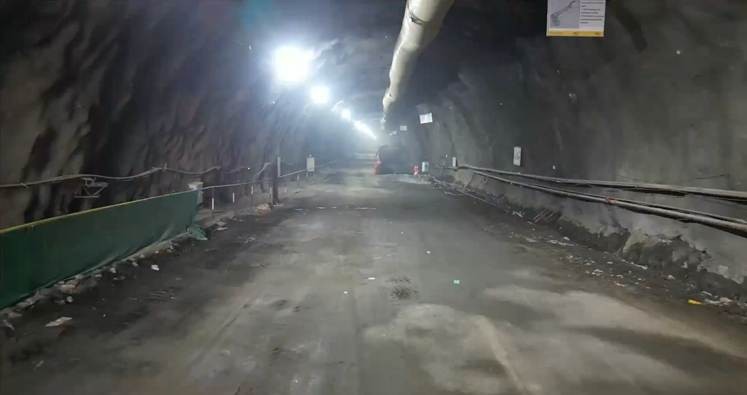
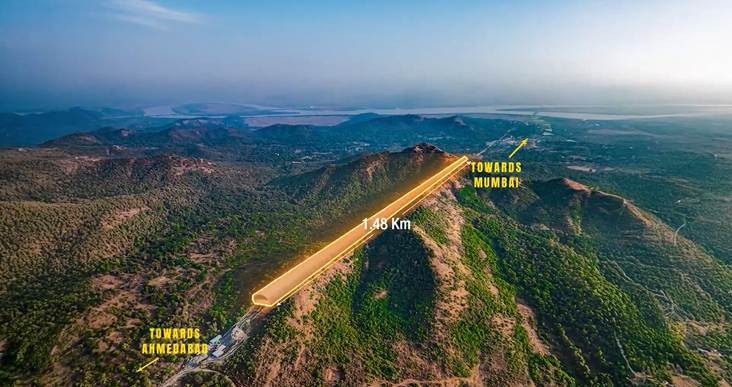
The breakthrough has been achieved in an approximately 1.5 km long mountain tunnel (MT-5), among the longest in Palghar district, located between Virar and Boisar bullet train stations.
The MT-5 tunnel was excavated from both ends and the excavation was completed within 18 months using a cutting-edge drill and blast method.
This method allows real-time monitoring of ground behaviour during excavation and enables the deployment of support systems such as shotcrete, rock bolts, and lattice girders based on actual site conditions. Throughout the tunnelling activities, all necessary safety precautions, including ventilation, fire prevention measures, and proper access and egress arrangements, have been meticulously followed.
Earlier, the first underground tunnel of approximately 5 km between Thane and BKC was completed in September 2025. The Mumbai-Ahmedabad High Speed Rail (MAHSR) project has a total length of 508 km, with an overall tunnel length of 27.4 km, of which 21 km comprises underground tunnels and 6.4 km surface tunnels. The project includes eight mountain tunnels, with seven tunnels in Maharashtra having a combined length of about 6.05 km, and one tunnel of 350 metres located in Gujarat.
The Union Minister said the Bullet Train Project is generating significant employment and will provide additional opportunities during operation. He highlighted that once completed, the project will reduce travel time between Mumbai and Ahmedabad to just 1 hour and 58 minutes, connecting and integrating the economies of major commercial centers.
The project is expected to foster economic activity along the corridor, facilitate knowledge transfer, and support the development of new industrial and IT hubs. The Union Minister noted that it will bring long-term economic gains and cater to the aspirations of the middle class by offering comfortable and affordable travel.
The Union Minister highlighted that the project, once completed, will lead to an estimated reduction of nearly 95 percent in carbon dioxide emissions compared to road transport.
In Maharashtra, work is underway on seven mountain tunnels. MT-1, with a length of 820 metres, has achieved 15 percent physical progress, while MT-2, measuring 228 metres, is currently under preparatory works. MT-3, with a length of 1,403 metres, has recorded 35.5 percent completion, and MT-4, measuring 1,260 metres, has achieved 31 percent progress.MT-6, measuring 454 metres, has progressed to 35 percent, while MT-7, with a length of 417 metres, has achieved 28 percent completion, taking the total length of mountain tunnels in Maharashtra to about 6 km.
The MAHSR spans approximately 508 kilometres, covering 352 km in Gujarat and Dadra & Nagar Haveli, and 156 km in Maharashtra. The corridor will connect major cities including Sabarmati, Ahmedabad, Anand, Vadodara, Bharuch, Surat, Bilimora, Vapi, Boisar, Virar, Thane, and Mumbai, marking a transformative step in India’s transportation infrastructure.
Support Our Journalism
We cannot do without you.. your contribution supports unbiased journalism
IBNS is not driven by any ism- not wokeism, not racism, not skewed secularism, not hyper right-wing or left liberal ideals, nor by any hardline religious beliefs or hyper nationalism. We want to serve you good old objective news, as they are. We do not judge or preach. We let people decide for themselves. We only try to present factual and well-sourced news.
Support objective journalism for a small contribution.