India test-fires rail-launched Agni Prime with 2,000 km range; joins US, Russia, China in mobile missile club
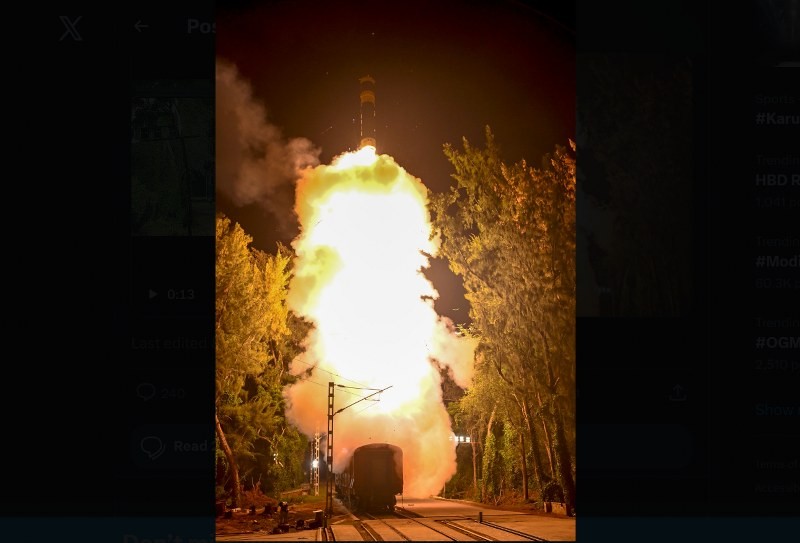
New Delhi: India on Thursday successfully test-fired the intermediate-range, nuclear-capable Agni Prime missile, Defence Minister Rajnath Singh announced on X, posting video of the dramatic lift-off.
The canisterised missile, with an estimated range of 2,000 km, was launched from a specially prepared rail-mounted launch bed towed by an Indian Railways locomotive — a deployment that signals a step-change in launch mobility.
The test is notable not because India regularly conducts weapons trials, but because firing a long-range missile from a railcar places New Delhi in a small club of powers with demonstrated rail-based mobile strike options — alongwith Russia, the United States and China.
North Korea has previously claimed similar railway-borne launches in 2021.
The rail launch allows forces to disperse and move launchers across the network, increasing survivability and shortening reaction times.
“… the first-of-its-kind launch was carried out from a specially-designed, rail-based mobile launcher,” the Defence Minister said, adding that the system “… has the capability to move on the rail network without pre-conditions (and) that allows shorter reaction time and cross-country mobility.”
He further said: "This successful test has put India in a group of select nations that have developed canisterised-launch systems from on-the-move rail networks."
India has carried out the successful launch of Intermediate Range Agni-Prime Missile from a Rail based Mobile launcher system. This next generation missile is designed to cover a range up to 2000 km and is equipped with various advanced features.
— Rajnath Singh (@rajnathsingh) September 25, 2025
The first-of-its-kind launch… pic.twitter.com/00GpGSNOeE
Practically, a rail-based firing option lets the armed forces use remote rail links as launch points even where road access is poor.
With roughly 70,000 km of track — India’s rail network is among the world’s largest — the Defence Ministry says the move expands launch geometry, complicates adversary targeting and offers concealment options such as tunnels.
Officials described the trial as a validation of the missile’s mobility, canisterisation and launch-from-motion concepts; they said further tests and operational evaluation will inform any deployment decisions.
Support Our Journalism
We cannot do without you.. your contribution supports unbiased journalism
IBNS is not driven by any ism- not wokeism, not racism, not skewed secularism, not hyper right-wing or left liberal ideals, nor by any hardline religious beliefs or hyper nationalism. We want to serve you good old objective news, as they are. We do not judge or preach. We let people decide for themselves. We only try to present factual and well-sourced news.
Support objective journalism for a small contribution.