Indian firm Mati Carbon wins $50 million in Elon Musk-backed XPRIZE for carbon removal using crushed rock
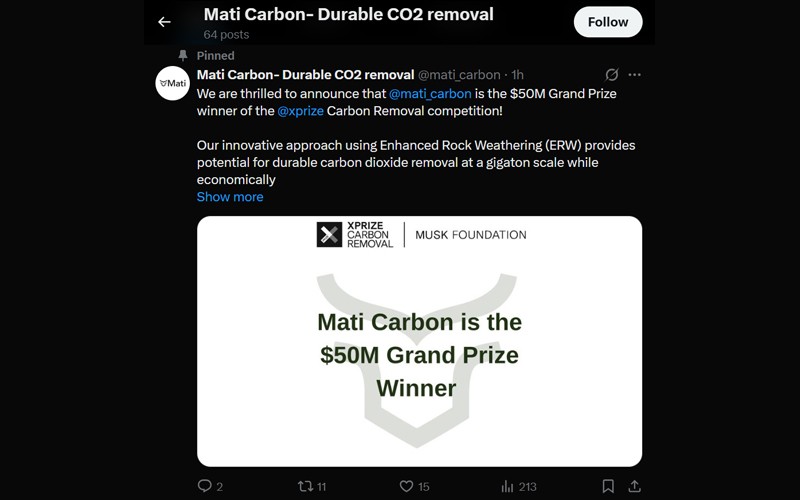
Washington: An Indian climate-tech startup has won the $50 million grand prize in the XPRIZE Carbon Removal competition, backed by Elon Musk's foundation, for its low-cost method of drawing carbon dioxide out of the atmosphere using crushed rock, AP reported.
Mati Carbon topped a pool of more than 1,300 teams from 88 countries competing over four years in a bid to scale up carbon-removal solutions.
Not a substitute for cutting emissions, say organisers
“It's important that we not promote carbon dioxide removal as a replacement for emissions reduction,” Michael Leitch, technical lead for the competition, was quoted as saying by AP. “But the race is really on both to dramatically reduce our existing emissions and also deploy carbon dioxide removal solutions at very, very large scales globally.”
The award comes as Musk's Department of Government Efficiency cuts funding to key science agencies like NOAA and the National Weather Service, while the Trump administration continues to dismantle several environmental regulations, including those that curb carbon emissions.
XPRIZE eyes more climate-focused innovation challenges
Though funded by the Musk Foundation, the XPRIZE competition operates independently.
Its executive director, Nikki Batchelor, said the organisation is now exploring contests on other climate fronts—methane removal, reforestation, and building resilience to climate impacts.
How Mati Carbon’s method works
Mati Carbon’s approach, known as enhanced rock weathering, mimics a natural carbon capture process.
When rain mixes with carbon dioxide in the atmosphere, it forms carbonic acid.
This acid reacts with rocks, forming bicarbonate—a stable compound that eventually washes into the ocean and stores carbon for millennia.
The firm accelerates this process by spreading pre-crushed basalt—a mineral-rich volcanic rock—across farmland. Jake Jordan, Mati Carbon’s chief science officer, said the basalt not only traps carbon but also releases nutrients that revitalise soil and improve crop yields.
CEO Shantanu Agarwal said the method offers "a solution to planetary-scale problems" while helping farmers, who often face the harshest effects of climate change.
Runners-up and other climate innovations
Besides Mati Carbon, other teams that removed at least 1,000 tonnes of carbon were also recognised.
NetZero, which received $15 million as the runner-up, converts crop residues like coffee husks into biochar, a charcoal-like substance that stores carbon in soil and improves its water and nutrient retention.
Other finalist projects explored deep storage of organic waste, ocean-based carbon absorption, and direct air capture of CO₂.
Scientists say multiple approaches will be needed
Rick Spinrad, former NOAA chief, praised the finalist technologies as “scientifically extraordinary concepts,” noting that a mix of solutions will likely be necessary to meet climate goals.
Leitch added that some non-winning technologies—such as direct air and ocean carbon capture—may prove more scalable over time. “It takes a lot of time and money to build, so I think time will tell,” he said.
Support Our Journalism
We cannot do without you.. your contribution supports unbiased journalism
IBNS is not driven by any ism- not wokeism, not racism, not skewed secularism, not hyper right-wing or left liberal ideals, nor by any hardline religious beliefs or hyper nationalism. We want to serve you good old objective news, as they are. We do not judge or preach. We let people decide for themselves. We only try to present factual and well-sourced news.
Support objective journalism for a small contribution.