


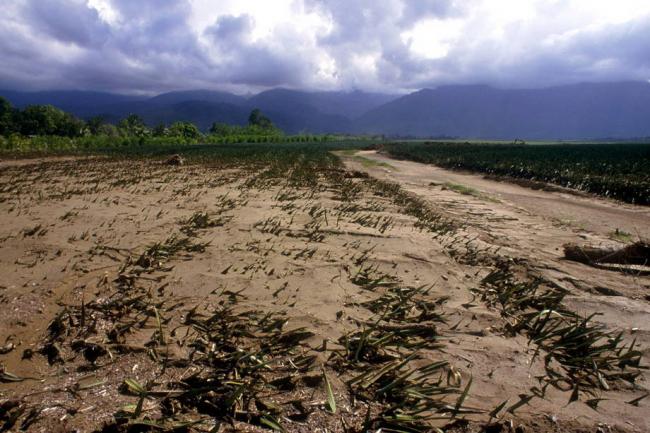
Climate change poses 'major threat' to food security, warns UN expert
“Increased frequency and intensity of extreme weather, rising temperatures and sea levels, as well as floods and droughts have a significant impact on the right to food,” said Hilal Elver, the UN Special Rapporteur on the right to food, in a news release.
“All these climate incidents will negatively impact on crops, livestock, fisheries, aquaculture and on people’s livelihoods,” she added, warning that responding to the food demand through large-scale production oriented agricultural models is not the right solution.
Elver also underlined that there is a need for a major shift from industrial agriculture to transformative systems such as agro-ecology that support the local food movement, protect small holder farmers, respect human rights, food democracy and cultural traditions, and at the same time maintain environmental sustainability and facilitate a healthy diet.
“Those who have contributed the least to global warming are the ones set to suffer the most from its harmful effects,” she stressed.
She added, “Urgent action is needed to respond to the challenges posed by climate change, but mitigation and adaptation policies should respect the right to food as well as other fundamental human rights.”
The Special Rapporteur made her recommendations in advance of the UN climate change conference, known as COP 21 due to take place in Paris from 30 November to 11 December.
The aim of the summit is to achieve a universally applicable legal instrument under the UN Framework Convention on Climate Change (UNFCCC) to reduce greenhouse gas emissions.
“Civil society pressure is mounting on the parties of the UNFCCC to achieve results in Paris by adopting a human rights approach to the climate change agreement that will respect, protect and fulfil human rights of all persons, and especially those most vulnerable. Any agreement must include a clear commitment by all relevant parties to ensuring climate justice and food security for all,” Elver said.
“As jointly stated by all special procedure mandate holders on World Environment Day in June, Governments should ?make sure that human rights are at the core of climate change governance.’”
Meanwhile, the Special Rapporteur highlighted her concerns surrounding the impact of climate change on the right to food in her recent report presented to the UN General Assembly’s Third Committee in October.
Independent experts or special rapporteurs are appointed by the Geneva-based UN Human Rights Council to examine and report back on a country situation or a specific human rights theme. The positions are honorary and the experts are not UN staff, nor are they paid for their work.
Photo: FAO/L. Dematteis
Support Our Journalism
We cannot do without you.. your contribution supports unbiased journalism
IBNS is not driven by any ism- not wokeism, not racism, not skewed secularism, not hyper right-wing or left liberal ideals, nor by any hardline religious beliefs or hyper nationalism. We want to serve you good old objective news, as they are. We do not judge or preach. We let people decide for themselves. We only try to present factual and well-sourced news.
Support objective journalism for a small contribution.


