


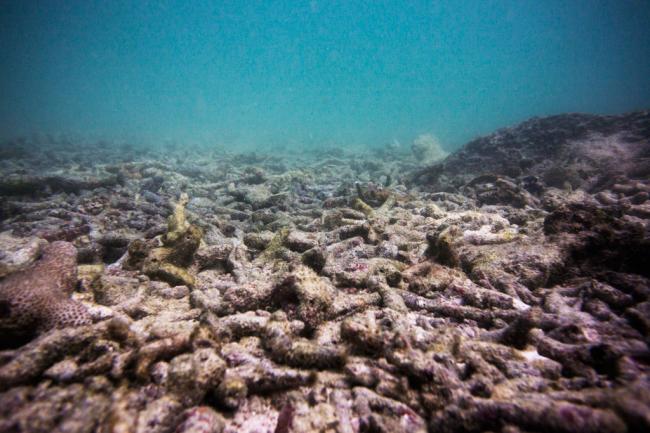
Climate change will lead to annual coral bleaching, UN-supported study predicts
The finding is part of a study funded by the UN Environment Programme (UNEP) and partners, which reviewed new climate change projections to predict which corals will be affected first and at what rate. The report is published in the journal Nature Scientific Reports .
Researchers found that the reefs in Taiwan and the Turks and Caicos archipelago will be among the first to experience annual bleaching, followed by reefs off the coast of Bahrain, in Chile and in French Polynesia.
Calling the predictions “a treasure trove” for environmentalists, the head of the UN agency, Erik Solheim said the projects allow conservationists and governments to prioritize the protection reef protection.
“The projections show us where we still have time to act before it's too late,” Solheim said.
On average, the reefs will start to undergo annual bleaching starting in 2014, according to the study. Without the required minimum of five years to regenerate, the annual occurrences will have a deadly effect on the corals and disrupt the ecosystems which they support.
However, if Governments act on emission reduction pledges made in the Paris Agreement, which calls on countries to combat climate change and limit global temperature rise to below 2 degrees Celsius, the corals would have another 11 years to adapt to the warming seas.
Between 2014 and 2016, the world witnessed the longest global bleaching event recorded. Among the casualties was the Great Barrier Reef, with 90 per cent of it bleached and 20 per cent of the reef's coral killed.
Photo: Kadir van Lohuizen/NOOR
Source: www.justearthnews.com
Support Our Journalism
We cannot do without you.. your contribution supports unbiased journalism
IBNS is not driven by any ism- not wokeism, not racism, not skewed secularism, not hyper right-wing or left liberal ideals, nor by any hardline religious beliefs or hyper nationalism. We want to serve you good old objective news, as they are. We do not judge or preach. We let people decide for themselves. We only try to present factual and well-sourced news.
Support objective journalism for a small contribution.


