


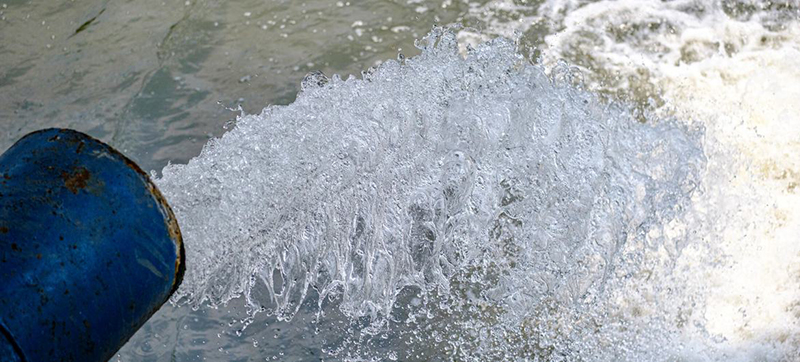
 Wastewater
Don’t let wastewater opportunities flow down the drain
Wastewater, long seen as an environmental and health hazard, possesses untapped potential as an alternative energy and clean water source to offset fertilizer use, the UN Environment Programme (UNEP) said on Wednesday.
In its new report, Wastewater: Turning problem to solution, UNEP warned that only 11 per cent of treated wastewater is reused while around half of the world’s untreated wastewater still enters rivers, lakes and seas.
Furthermore, CO2 emissions from wastewater are substantial, hovering slightly below those from the global aviation industry.
With the right policies in place, wastewater could provide alternative energy to half a billion people, supply over 10 times the water obtained through desalination processes and reduce the demand for synthetic fertilizers.
‘Full of potential’
“Globally, wastewater is full of potential, yet it is currently allowed instead to contaminate the ecosystems we rely on,” said Leticia Carvalho, Head of Marine and Freshwater Branch at UNEP.
“We must not let the opportunity simply disappear down the drain: it’s time to realize the promise of wastewater as an alternative source of clean water, energy, and important nutrients.”
The launch of the report, a joint publication by UNEP, the Global Wastewater Initiative (GWWI) platform and GRID-Arendal, a Norwegian non-profit organization, is a centrepiece of this year’s World Water Week currently underway.
Potential solutions
It highlights wastewater’s potential to morph from a climate concern to a solution.
By generating biogas, heat, and electricity, wastewater could produce five times more energy than is needed for its treatment.
Moreover, proper wastewater management could help countries adapt to climate change and reduce water insecurity. Reusing nitrogen, phosphorous, and potassium from wastewater could offset 13.4 percent of the global agricultural nutrient demand.
Proper management of wastewater also has the potential to irrigate around 40 million hectares – an area larger than Germany.
Successful examples
The report also offers successful wastewater management examples from various countries, both high and low-income, including China, Colombia, Denmark, Egypt, Germany, India, Israel, Namibia, Senegal, Sweden, Singapore, the Solomon Islands, and Tunisia, as well as from the Caribbean region.
The initiatives demonstrate the potential for scalable solutions across multiple climate zones and economies.
It also urges governments and businesses to look at wastewater as a “circular economy” opportunity, outlining the potential jobs and revenue the valuable resource can generate.
“We need to keep the pressure up to improve some critical underlying conditions if these actions are to succeed,” said Peter Harris, Director of GRID-Arendal.
“For that to happen, we need more effective governance, investment, supporting innovation, strengthening data, improving capacity to implement and – critically shifting our behaviour – all of us as individuals and institutions.”
Support Our Journalism
We cannot do without you.. your contribution supports unbiased journalism
IBNS is not driven by any ism- not wokeism, not racism, not skewed secularism, not hyper right-wing or left liberal ideals, nor by any hardline religious beliefs or hyper nationalism. We want to serve you good old objective news, as they are. We do not judge or preach. We let people decide for themselves. We only try to present factual and well-sourced news.
Support objective journalism for a small contribution.


