


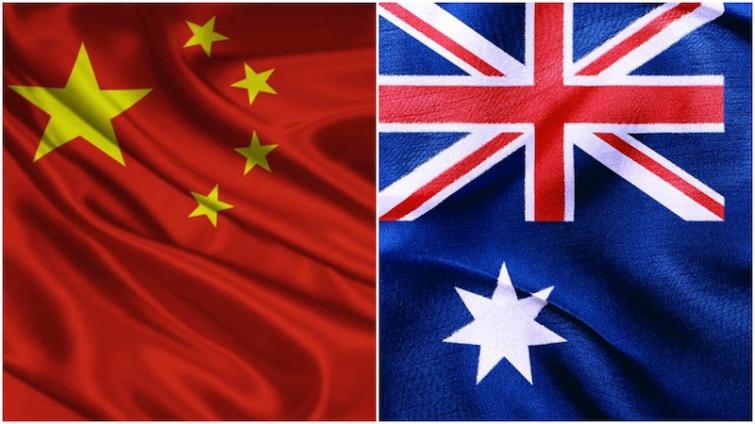
 Australia-China
Experts see no improvement in Australia-China bond next year
Melbourne: Experts believe the deteriorating relationship between Australia and China may not be brighter in 2021.
Although Australian Prime Minister Scott Morrison has stressed his openness to dialogue for resolving tensions, few observers see a diplomatic breakthrough on the horizon as Canberra and Beijing show no sign of budging on what appear to be increasingly non-negotiable differences, journalist John Power wrote in his article published in South China Morning Post.
Among dovish and hawkish voices alike, there is a growing belief that the antagonistic relations of the past year could become the new normal, or even be just the beginning of a spiral of escalation and recrimination, he wrote.
China’s “wolf warrior” diplomacy and imposition of restrictions on A$20 billion (US$15.2 billion) of Australian exports have prompted Canberra and even the Australia China Business Council to rule out any compromise on core values in the face of perceived bullying and threats, while galvanising calls for international cooperation to counter Chinese economic coercion, the journalist wrote.
Beijing, meanwhile, has insisted Canberra take “concrete actions” to repair ties, after earlier this year issuing a dossier of 14 grievances – including Australia’s call for an inquiry into the origins of the Covid-19 pandemic, its ban on Huawei, and “antagonistic” media reports about China – that it said had “poisoned” relations, he wrote.
Among dovish and hawkish voices alike, there is a growing belief that the antagonistic relations of the past year could become the new normal, or even be just the beginning of a spiral of escalation and recrimination.
While dialogue continues at the consular level, Canberra has complained that the Chinese side has shunned offers of ministerial-level talks.
The view in Australia, increasingly, is that it needs to “accept relations with China will not improve in the near term and that we need to take significant steps to adjust”, Dominic Meagher, visiting fellow at the Australian National University’s College of Asia and the Pacific was quoted as saying by the South China Morning Post.
Bob Carr, who served as Australia’s foreign minister from 2012 to 2013, told the newspaper: "I wish China wasn’t taking tit-for-tat measures, but I think it’s far more likely that this breakdown in the relationship will continue for the better part of a decade than it would be resolved with a bit of deft diplomacy."
Qinduo Xu, a senior fellow at the Pangoal Institution in Beijing, said it was “natural” China would respond forcefully to policies that treated it as a threat, suggesting Canberra’s pandemic inquiry proposal seemed “more about politics, more about targeting China” than an effort to gather the facts.
“Some Chinese analysts would say Australia now is not playing the deputy sheriff of Washington, it is playing the role of sheriff in chief in the anti-China campaign from mostly Western countries,” he said.
The trade war between China and Australia has escalated in recent times.
Support Our Journalism
We cannot do without you.. your contribution supports unbiased journalism
IBNS is not driven by any ism- not wokeism, not racism, not skewed secularism, not hyper right-wing or left liberal ideals, nor by any hardline religious beliefs or hyper nationalism. We want to serve you good old objective news, as they are. We do not judge or preach. We let people decide for themselves. We only try to present factual and well-sourced news.
Support objective journalism for a small contribution.


