


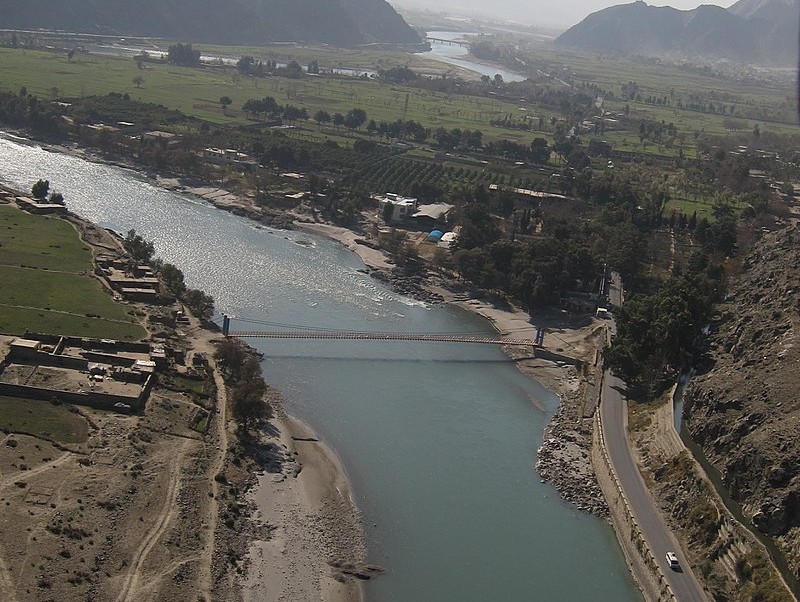
Following India's suit, Afghanistan builds dams on Kunar River; restricting Pakistan’s access to water
Afghanistan’s Taliban government has decided to build a series of dams across the Kunar River, a major tributary of the Indus, in a move seen as an attempt to restrict Pakistan’s access to water.
The decision came under direct orders from Supreme Leader Mawlawi Hibatullah Akhundzada, according to the country’s acting Water Minister Mullah Abdul Latif Mansoor, who announced the plan on X.
In his post, Mansoor said Afghans “have the right to manage their own water,” adding that construction would be carried out by domestic companies rather than foreign contractors.
By the directive of the esteemed Amir al-Mu'minin (may Allah protect him), construction of a hydroelectric dam on the Kunar River will soon begin.
— RTA English (@rtaenglish1) October 24, 2025
Mullah Abdul Latif Mansoor, the Minister of Energy and Water, said that Afghans have the right to manage their own water resources.… pic.twitter.com/oguhLCZTzR
The minister’s remarks underline Kabul’s urgency as tensions rise along the Durand Line, the disputed 2,600-kilometre border with Pakistan, amid Islamabad’s accusations that the Taliban is backing the Tehreek-e-Taliban Pakistan (TTP), a banned terror group.
The Taliban’s new dam initiative mirrors India’s recent suspension of the Indus Waters Treaty (IWT) with Pakistan following the Pahalgam terror attack in April this year.
India’s move halted a 65-year-old water-sharing agreement, leaving Pakistan increasingly vulnerable to upstream control of key rivers.
The Kunar River: A strategic lifeline
Originating in Pakistan’s Chitral district in the Hindu Kush mountains, the Kunar River flows south into Afghanistan through Kunar and Nangarhar provinces, before merging with the Kabul River.
The combined flow then re-enters Pakistan and joins the Indus River near Attock in Punjab province.
The river system is crucial to Pakistan’s irrigation, drinking water, and hydroelectric power, particularly in the Khyber Pakhtunkhwa region, which has already been hit hard by reduced water availability.
Analysts warn that if Afghanistan builds multiple dams along the Kunar and Kabul rivers, Pakistan could face severe water shortages, especially since, unlike India and Pakistan, there is no formal water-sharing treaty between Islamabad and Kabul.
This lack of legal framework leaves Pakistan with little leverage to contest Afghanistan’s plans.
The Taliban’s broader water strategy
Since returning to power in August 2021, the Taliban has prioritised control over rivers and canals across Afghanistan, framing it as essential for food and energy security.
A key example is the massive Qosh Tepa Canal project in northern Afghanistan, a 285-kilometre canal designed to irrigate over 550,000 hectares of arid land.
Experts have cautioned that the Qosh Tepa Canal could divert up to 21% of the Amu Darya’s flow, potentially worsening water scarcity in Uzbekistan and Turkmenistan.
Last week, Taliban Foreign Minister Amir Khan Muttaqi visited India, where both sides discussed cooperation on hydroelectric and irrigation projects.
A joint statement noted that “both sides underscored the importance of sustainable water management and agreed to cooperate on hydroelectric projects with a view to addressing Afghanistan’s energy needs and supporting its agricultural development.”
Afghanistan’s push to build dams on rivers feeding into Pakistan, combined with India’s suspension of the Indus Waters Treaty, underscores a new phase of regional water geopolitics in South Asia.
Experts warn that unless a framework for transboundary water management is established, tensions between Islamabad and Kabul could escalate further, adding a new layer of complexity to an already volatile relationship.
Support Our Journalism
We cannot do without you.. your contribution supports unbiased journalism
IBNS is not driven by any ism- not wokeism, not racism, not skewed secularism, not hyper right-wing or left liberal ideals, nor by any hardline religious beliefs or hyper nationalism. We want to serve you good old objective news, as they are. We do not judge or preach. We let people decide for themselves. We only try to present factual and well-sourced news.
Support objective journalism for a small contribution.


