


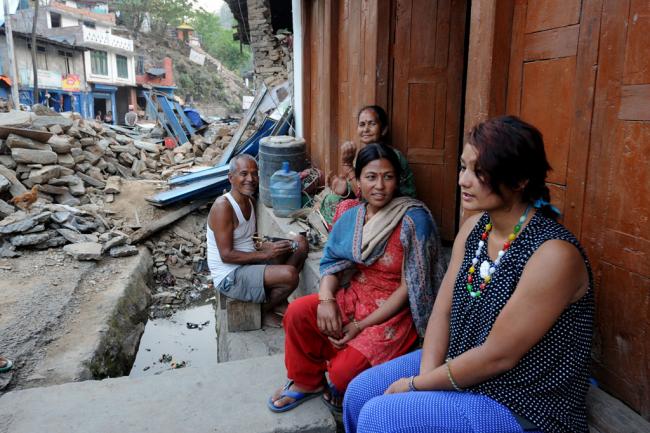
Fundamental change needed to address women's health in conflicts: UN
“One of the weakest areas of resilience currently is among women and girls, and the institutions that serve them,” the UN Population Fund (UNFPA) said in its annual State of World Population Report, this year, entitled Shelter from the Storm: A transformative agenda for women and girls in a crisis-prone world.
“As long as inequality and inequitable access short-circuit their rights, abilities and opportunities, women and girls will remain among those most in need of humanitarian assistance and least equipped to contribute to recovery or resilience,” it added.
“The demand for humanitarian assistance has grown every year since 2011, but funding has not increased at the same pace, leaving unprecedented gaps, translating into inadequate or insufficient responses for millions of people in need,” according to the report.
In a foreword, UNFPA Executive Director Babatunde Osotimehin noted that every day, 507 women and adolescents die from pregnancy and childbirth complications in emergency situations and in fragile States, despite the “remarkable progress” of the past decade to protect their health and rights.
“Together we must transform humanitarian action by placing the health and rights of women and young people at the centre of our priorities,” he wrote.
“Together we must strive for a world where women and girls are no longer disadvantaged in multiple ways but are equally empowered to realize their full potential, and contribute to the development and stability of their communities and nations – before, during or after a crisis,” he added.
The report noted that in a fragile world, women and girls pay a disproportionate price due to discrimination and gender inequality that see them enjoying less of almost everything – income, land and other assets, access to health services, education, social networks, a political voice, equal protection under the law, and the realization of basic human rights.
“By many measures, more countries are considered fragile than five or six years ago, leaving them more vulnerable to conflict or the effects of disasters,” it stressed.
It added, “When a crisis strikes, women and girls are disproportionately disadvantaged and less prepared or empowered to survive or recover.”
It called for moving sexual and reproductive health to the centre of humanitarian action.
“A fundamental shift is needed: away from reacting to disasters and conflicts as they unfold and sometimes linger for decades, towards prevention, preparedness and empowerment of individuals and communities to withstand and recover from them,” said the report.
“Wherever feasible, humanitarian assistance can challenge existing forms of discrimination, such as through providing comprehensive services for survivors of gender-based violence. It can enlist men and boys in building acceptance of new social norms, such as around women’s inherent rights and the peaceful resolution of differences,” according to the report.
“The health and rights of women and adolescents should not be treated like an afterthought in humanitarian response,” Dr. Osotimehin said, adding: “For the pregnant woman who is about to deliver, or the adolescent girl who survived sexual violence, life-saving services are as vital as water, food and shelter.”
Photo: UNICEF/Chandra Shekhar Karki/www.justearthnews.com
Support Our Journalism
We cannot do without you.. your contribution supports unbiased journalism
IBNS is not driven by any ism- not wokeism, not racism, not skewed secularism, not hyper right-wing or left liberal ideals, nor by any hardline religious beliefs or hyper nationalism. We want to serve you good old objective news, as they are. We do not judge or preach. We let people decide for themselves. We only try to present factual and well-sourced news.
Support objective journalism for a small contribution.


