


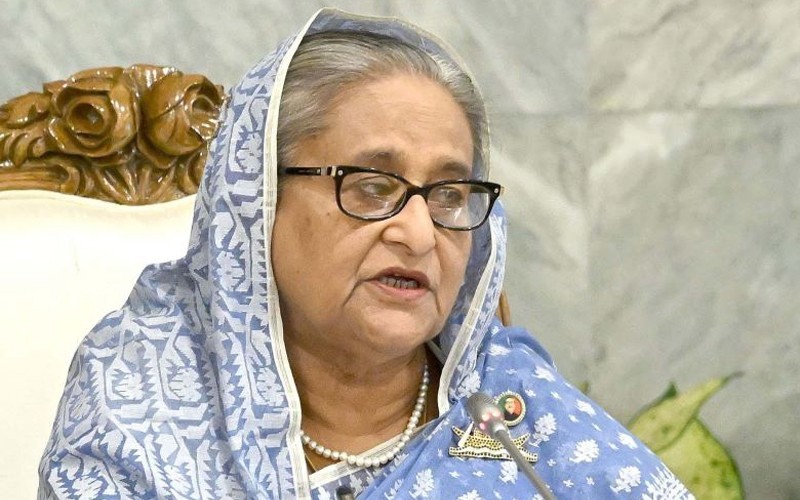
 Sheikh Hasina
How a 1:30 pm call from 'top official in India' saved Hasina's life, reveals new book
New Delhi/IBNS: A forthcoming book has unveiled a gripping new account of how a single phone call from India altered the course of Bangladesh’s modern political history — and ultimately saved Sheikh Hasina’s life.
According to Inshallah Bangladesh: The Story of an Unfinished Revolution — authored by Deep Halder, Jaideep Mazumdar, and Sahidul Hasan Khokon, and published by Juggernaut — the former Bangladeshi Prime Minister was still inside her official residence, Ganabhaban, in Dhaka around 1:30 p.m. on August 5, 2024, when she received a crucial call from “a top official in India she knew well.”
Within minutes of that exchange, Hasina made the life-saving decision to flee, a choice the authors describe as the one that kept her from sharing her father Sheikh Mujibur Rahman’s tragic fate.
What happened that day?
That morning, tension had been building across Dhaka.
An enraged mob was closing in — barely two kilometres from Ganabhaban — while the country’s top military officers, including Army Chief General Waker-uz-Zaman and the heads of the Air Force and Navy, repeatedly urged Hasina to evacuate.
She refused each time. Even her sister, Sheikh Rehana, and son, Sajeeb Wazed, speaking from the United States, failed to change her mind.
“She would rather die than abandon her country,” the book recounts.
Everything changed after the 1:30 p.m. call.
“It was a short call,” the authors note.
The Indian official warned Hasina that the situation had reached a point of no return — and urged her to leave immediately if she wished to live.
“You must live to fight another day,” the Indian official reportedly told her.
Shocked but resolute, Hasina spent the next thirty minutes weighing her options.
She asked for permission to record a farewell message before leaving, but her security chiefs refused, fearing the mob would soon breach the compound.
Moments later, Sheikh Rehana is said to have pulled her sister into an SUV and rushed her to the helipad with just two suitcases of clothes.
At 2:23 pm, a helicopter lifted off from Ganabhaban, reaching the Tejgaon air base twelve minutes later.
By 2:42 pm, a C-170J aircraft carrying Hasina departed from Bangladesh, entering Indian airspace over Malda in West Bengal roughly twenty minutes later.
“The take-off coincided with another brief spell of rain,” the book describes, adding to the dramatic escape.
That same evening, the aircraft landed at Hindon Airbase near Delhi, where India’s National Security Advisor Ajit Doval personally received the exiled leader.
The NSA then escorted Hasina to a secure, undisclosed location — marking the beginning of Sheikh Hasina’s political exile in India.
The book, slated for release soon, promises to reveal new details about one of the most turbulent chapters in South Asia’s recent history — and how a single phone call across the border may have changed it forever, according to reports.
Support Our Journalism
We cannot do without you.. your contribution supports unbiased journalism
IBNS is not driven by any ism- not wokeism, not racism, not skewed secularism, not hyper right-wing or left liberal ideals, nor by any hardline religious beliefs or hyper nationalism. We want to serve you good old objective news, as they are. We do not judge or preach. We let people decide for themselves. We only try to present factual and well-sourced news.
Support objective journalism for a small contribution.


