


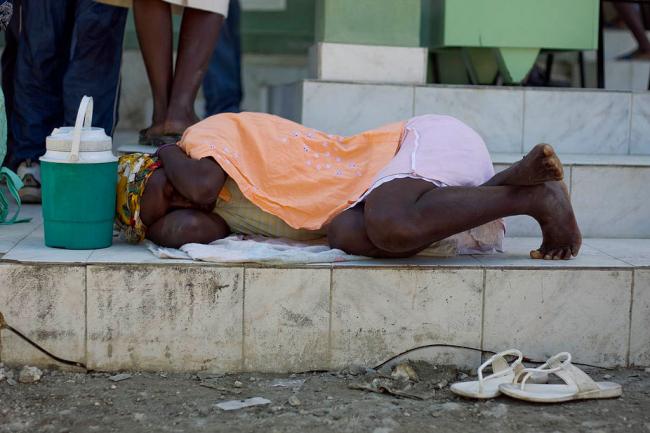
INTERVIEW: UN health official discusses unprecedented vaccination campaign to tackle cholera in Haiti
“The health system is very weak […] so we must use every single tool to ensure that cholera is reduced further in this country,” said Poncelet in an interview with the United Nations News Service.”
WHO is embarking on a large-scale vaccination programme in 2016 and 2017 that aims to reach an unprecedented 750,000 people in the administrative area known as Department Centre. “With 1.5 million doses, it is the first time that such a programme will be undertaken.”
Poncelet said that the vaccine, developed about five years ago and having an efficacy of 65 per cent, has been well-received by the local population. He added that it is important to understand that merely by the application of the vaccine, cholera will not be eliminated. “[Nonetheless] it will be a strong contributor to it,” he stressed.
Recalling a meeting of health experts in Haiti in April 2016, he underlined that it is very important that people, especially those receiving the vaccine, have access to chlorinated drinking water.
“By applying this [two-pronged] approach – water chlorination and vaccines – the number of cases in the department can be reduced,” said Poncelet.
Emphasizing the importance of sustained funding, he said that due to new “hot-spots” such as Syria and Sudan, as well as a level of “donor fatigue,” funds are declining for programmes in Haiti.
He further expressed hope that with the new strategies, use of new tools and building on the experience WHO has gained in Haiti and in other countries, new cases of cholera will be reduced.
On wider WHO programmes in the country, Poncelet explained that the agency has been supporting the implementation of a 10-year national plan which has four critical components, including surveillance programmes to identify any new cases of the disease; response programmes that deploy teams including physicians, health promoters and water and sanitation experts; programmes to chlorinate water both at the household and at the distribution level; and water and sanitation programmes such as increasing access to latrines and sewage syste
Photo: UN/MINUSTAH/Logan Abassi
Source: www.justearthnews.com
Support Our Journalism
We cannot do without you.. your contribution supports unbiased journalism
IBNS is not driven by any ism- not wokeism, not racism, not skewed secularism, not hyper right-wing or left liberal ideals, nor by any hardline religious beliefs or hyper nationalism. We want to serve you good old objective news, as they are. We do not judge or preach. We let people decide for themselves. We only try to present factual and well-sourced news.
Support objective journalism for a small contribution.


