


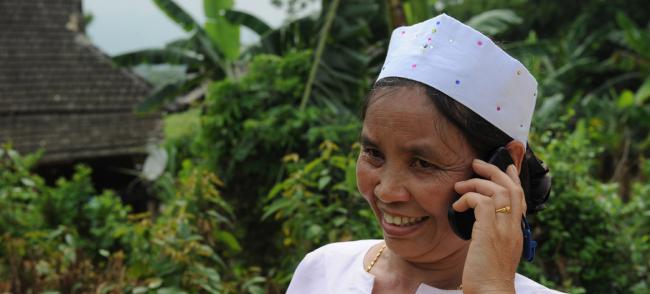
New communications technologies essential to empower poor rural women – UN
New York, Mar 9 (JEN): To mark International Women’s Day, the three United Nations Rome-based agencies are spotlighting the role new innovations in information and communications technologies (ICTs) can play in expanding opportunities for rural women, who often find themselves “on the wrong side of the digital divide.”
In Rome on Thursday, the International Fund for Agricultural Development (IFAD), UN Food and Agriculture Organization(FAO) and World Food Programme (WFP) are leading the talks, which explores how women’s empowerment and greater equality are inseparable from achieving sustainable development.
"At IFAD we have seen how information communications technologies can be powerful catalysts for political and social empowerment of women, and the promotion of gender equality if rightly designed, accessible and usable," said Gilbert F. Houngbo, IFAD President in his opening remarks at the IFAD-hosted event – highlighting how women’s empowerment and greater equality are inseparable from achieving sustainable development.
“At IFAD, we have seen how information communications technologies can be powerful catalysts for political and social empowerment of women, and the promotion of gender equality if rightly designed, accessible and usable,” said Gilbert F. Houngbo, IFAD President, in his opening remarks at the event, which the agency hosted.
Only 41 per cent of women in low- and middle-income countries own mobile phones, compared to 46 per cent for men. Nearly two-thirds of women living in the South Asia and East Asia and Pacific sub-regions do not own a mobile phone.
Rural women often lack access to health care, education, decent work and social protection.
“The global rise of information has deeply affected rural women in poor countries, who often find themselves on the wrong side of the digital divide: because they live in developing countries, in rural areas, and because they are women, leaving them more likely poor and vulnerable to economic and climatic shocks,” explained FAO Director-General José Graziano da Silva.
“If the interests and needs of rural women and girls are addressed, there is significant potential for information and communication technology to foster gender equality and the improvement of rural livelihoods,” he added.
ICTs can go a long way to boosting economic opportunities for rural women. For example, mobile and smartphones, provide access to real-time prices, offering informed choices about where and when to buy and sell.
Studies indicate that when women earn money, they are more likely than men to spend it on their families’ food and children’s education.
“Digital technology can transform lives if we get it into the hands of the people who need it, and that's why we’re working hard every day to help increase access for rural women,” underscored WFP Executive Director David Beasley.
“And every time one of those women farmers uses a WFP app to sell her crops, the prosperity of her family and her community improves and we're another step closer to gender equity," he elaborated.
International Women’s Day is a time to call for change and celebrate acts of courage and determination by ordinary women who have played an extraordinary role in the history of their countries and communities.
FAO/Hoang Dinh Nam
Support Our Journalism
We cannot do without you.. your contribution supports unbiased journalism
IBNS is not driven by any ism- not wokeism, not racism, not skewed secularism, not hyper right-wing or left liberal ideals, nor by any hardline religious beliefs or hyper nationalism. We want to serve you good old objective news, as they are. We do not judge or preach. We let people decide for themselves. We only try to present factual and well-sourced news.
Support objective journalism for a small contribution.


