


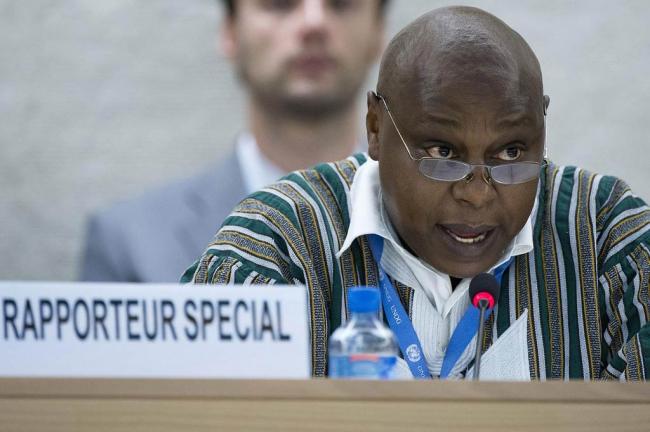
New law threatens civil society independence in Kazakhstan: UN expert
The new draft law sets up an operator with rights to allocate both governmental and non-governmental grants, which includes grants from international organizations, diplomatic missions or international not-for-profit organizations, to non-governmental organizations.
“The possibility for a centralized Government’s operator to distribute all grants irrespective of sources, be it public or private funds, enables the authorities to arbitrarily limit resources and to control the entire not-for-profit sector,” Kiai cautioned.
“By controlling the sources of funds, the draft law would limit associations’ functional autonomy and put their independence and existence at serious risk,” he said.
The expert underscored that access to financial resources is a vital and integral part of the right to freedom of association.
Additionally, he recalled that similar appeals were made at the end of his visit to Kazakhstan earlier this year, including maintaining the independence of associations and inclusion of civil society groups in public debate.
He reiterated his call to the Kazakh authorities to repeal the draft law.
The amendments which were adopted by the Senate last week, will now be held at the Lower House of Parliament for its final consideration.
The draft law also bars associations from using more than 10 per cent of governmental grants for administrative expenditures.
The UN expert noted that other countries which adopted such measures have had a devastating impact on civil society organizations.
“Many were forced to stop their activities, leaving society deprived from these organizations’ essential contribution in the economic, cultural, political and social fields and devoid of important voices often representing the most marginalized,” he added.
Kiai stressed that existence of free civil societies are crucial for a country with significant democratic and development aspirations as they ‘ensure diverse voices are included in decision making process.’
Independent experts or special rapporteurs are appointed by the Geneva-based UN Human Rights Council to examine and report back on a country situation or a specific human rights theme. The positions are honorary and the experts are not UN staff, nor are they paid for their work.
UN Photo/Jean-Marc Ferré
Support Our Journalism
We cannot do without you.. your contribution supports unbiased journalism
IBNS is not driven by any ism- not wokeism, not racism, not skewed secularism, not hyper right-wing or left liberal ideals, nor by any hardline religious beliefs or hyper nationalism. We want to serve you good old objective news, as they are. We do not judge or preach. We let people decide for themselves. We only try to present factual and well-sourced news.
Support objective journalism for a small contribution.


