


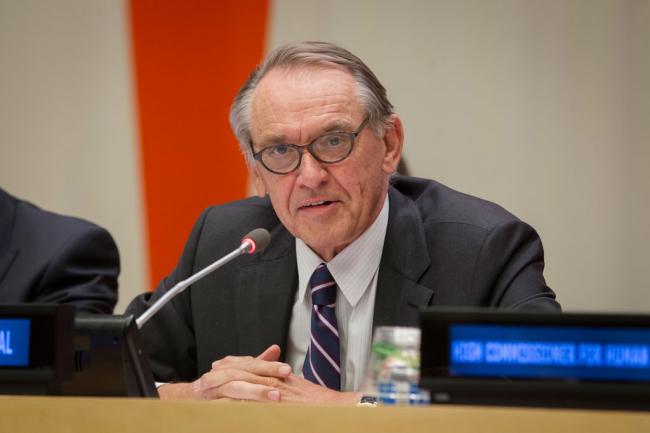
'No-one left behind' is ethical imperative of development agenda: UN deputy chief
“Fundamental principles that underpin the new goals are interdependence, universality and solidarity. They should be implemented by all segments of all societies, working together. No-one must be left behind. People who are hardest to reach should be given priority,” he said.
This is the underlying moral code of the 2030 Agenda for Sustainable Development. This demonstrates the Agenda’s profound ethical foundation.”
The Agenda, adopted unanimously by 193 Heads of State and other top leaders at a summit at UN Headquarters in New York in September, calls on all countries to achieve 17Sustainable Development Goals (SDGs) over the next 15 years, addressing the needs of people in both developed and developing countries.
Broad and ambitious in scope, the Agenda addresses the three dimensions of sustainable development: social, economic and environmental, as well as important aspects related to peace, justice and effective institutions.
“We must discard silo-thinking, we must integrate action across different sectors,” Eliasson said.
He added, “We must be informed by those whom we seek to support and listen to their aspirations. We must pursue these ambitious goals and targets on their behalf,” he added.
“We must be ready to think – and to act – comprehensively and holistically. Every actor, every country, every international and regional organization has a responsibility to work in synergy, translating the Agenda into practical realities on the ground,” he underscored.
The 17 SDGs build on the earlier eight Millennium Development Goals (MDGs), which specifically sought by 2015: to eradicate extreme poverty and hunger; achieve universal primary education; promote gender equality and empower women; reduce child mortality; improve maternal health; combat HIV/AIDS, malaria and other diseases; ensure environmental sustainability; and develop a global partnership for development.
But progress on these was uneven across regions and countries, leaving millions of people behind, especially the poorest and those disadvantaged due to sex, age, disability, ethnicity or geographic location. This is where the SDGs come in.
They stress everything from zero poverty, zero hunger, good health, quality education, gender equality, clean water and sanitation, and affordable clean energy, to decent work and economic growth, innovation, reduced inequalities, sustainable cities, responsible consumption, climate action, unpolluted oceans and land, and partnerships to achieve the goals.
UN Photo/Loey Felipe (file)
Support Our Journalism
We cannot do without you.. your contribution supports unbiased journalism
IBNS is not driven by any ism- not wokeism, not racism, not skewed secularism, not hyper right-wing or left liberal ideals, nor by any hardline religious beliefs or hyper nationalism. We want to serve you good old objective news, as they are. We do not judge or preach. We let people decide for themselves. We only try to present factual and well-sourced news.
Support objective journalism for a small contribution.


