


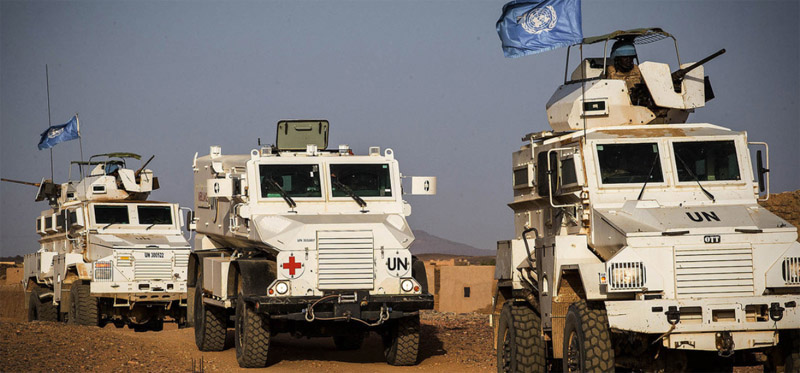
 Mali
Mali
‘Political, security, human rights and humanitarian challenges’ plague Mali
New York: With a deteriorating security situation in central and northern Mali, the UN peacekeeping chief told the Security Council on Tuesday that ‘blue helmets’, the Malian Defence and Security Forces, continue to suffer repeated attacks and significant losses, while some large towns “live under constant threat from armed groups”.
The head of UN Peace Operations, Jean-Pierre Lacroix, recalled that on Friday, heavily armed terrorists had attacked a UN Stabilization Mission (MINUSMA) camp in the Kidal region, killing four Chadian peacekeepers and wounding 34 others.
He said the assault was a tragedy, and an “illustration of the bravery and determination of our peacekeepers to support the people of Mali”, noting that the “determined and heroic defense inflicted a serious setback on the attackers”.
In addition to the terrorist threat, Mr. Lacroix expressed concern over the continuing “destabilizing activities of militias” operating along ethnic lines in the restive central region.
In a bid to that ensure militias and armed groups lay down their weapons and join the dialogue process, he called on the transitional Government to improve the security situation in parallel with protecting civilians and restoring State authority and basic social services.
Political ‘litmus test’
He maintained that the country’s long-term security hinges on the success of its fragile political transition.
The Malian Government has been seeking to restore stability and rebuild following a series of setbacks since early 2012, including a military coup d'état, renewed fighting between Government forces and Tuareg rebels, and the seizure of its northern territory by radical extremists.
Among other things, the UN mission, considered to be the most dangerous UN operation to serve in, supports the implementation of a 2015 Peace Agreement signed by the authorities and two coalitions of armed groups.
While pointing to some recent “encouraging signs”, including the kickstarting of several important institutions, he highlighted the importance of political and institutional reform, such as territorial redistricting as well as electoral and Constitutional law changes.
He said that “an official electoral calendar has not been issued”, pending agreement on various reforms, including poll management.
“At this critical juncture, we encourage Malian political actors to work in a spirit of compromise and enact reforms aimed at creating an environment conducive to peaceful, inclusive, transparent and credible elections”, said the peacekeeping chief.
“These elections represent the litmus test for the current transition and a necessary step towards the return of Mali to constitutional rule”, he said.
Translate commitments to peace
Conceding that the implementation of the Peace Agreement has been slow, Mr. Lacroix said that in recent weeks, a positive momentum and a new sense of trust among Malian parties has emerged.
He drew particular attention to the importance of two recent meetings as being “of major symbolic significance” and “essential steps” to improve Malians’ political representation, which he said was “a key factor in its implementation”.
Mr. Lacroix stressed that international support, including that of the Council, remains of “utmost importance to ensure that national stakeholders live up to their commitments”.
Support Our Journalism
We cannot do without you.. your contribution supports unbiased journalism
IBNS is not driven by any ism- not wokeism, not racism, not skewed secularism, not hyper right-wing or left liberal ideals, nor by any hardline religious beliefs or hyper nationalism. We want to serve you good old objective news, as they are. We do not judge or preach. We let people decide for themselves. We only try to present factual and well-sourced news.
Support objective journalism for a small contribution.


