


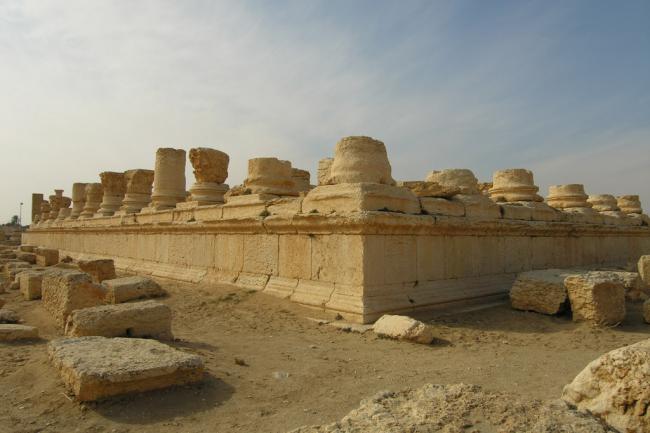
Safeguarding cultural heritage of Syria and Iraq is essential: UN officials
Meeting on the eve of the International Conference on the Protection of Victims of Ethnic and Religious Violence in the Middle East, being held in Paris on 8 September and jointly organized by the French and Jordanian Governments, in which the UNESCO Director-General will also participate.
The two UN officials also discussed the destruction of heritage and illicit trafficking, as well as persecutions of communities on religious and ethnic grounds, led by violent extremists, and in the context of a rising humanitarian crisis, involving millions of refugees as well as internally displaced persons (IDPs).
A press release from UNESCO said the Deputy Secretary-General and the Director-General discussed possible measures to counter the rise of violent extremism, including with young people, to strengthen the ground for living together in all societies, through education towards a global citizenship and enhancing knowledge about different cultures and about history.
“All of this shows the humanitarian crisis cannot be separated from cultural cleansing,” said Bokova.
She said, “These are part of the same strategic imperative and must stand at the heart of all efforts for peacebuilding. The cultural heritage and diversity of this region must be safeguarded for future peace, as part of the identity of all humanity.”
She highlighted here UNESCO's work with Member States to raise awareness and strengthen action, including through the #Unite4Heritage social media campaign, as well as the importance of the mobilization of the UN General Assembly, reflected in the resolution approved in May on “Saving the Cultural Heritage of Iraq,” initiated by Germany and Iraq – with the strong support also of the Deputy-Secretary-General.
“I have come today to express solidarity and support to the actions of UNESCO, to say I stand fully behind all UNESCO's efforts,” said Eliasson.
He said, “The destruction of humanity's common heritage are crimes against all of humanity, and a denial of identity to future generations. I make a passionate appeal today for the preservation of this cultural heritage as an issue of our common identity.”
In this context, Eliasson welcomed and congratulated the initiative of Foreign Ministers Laurent Fabius and Nasser Judeh, of France and Jordan, in organizing the International Conference on the Protection of Victims of Ethnic and Religious Violence in the Middle East, set to open tomorrow.
He underlined the impact of the crisis on Syria and Iraq, across the region as well as on Europe and the world, and said that his message will underline the need for a political strategy bringing together all relevant actions.
Eliasson underlined the great responsibility of the UN Security Council in this respect and the rising expectations of world public opinion for action to be taken – including to support IDPs in Syria and Iraq and refugees across the region and further afield – and to chart a path towards a political solution, working with all States in the region.
Photo: ©UNESCO/F. Bandarin
Support Our Journalism
We cannot do without you.. your contribution supports unbiased journalism
IBNS is not driven by any ism- not wokeism, not racism, not skewed secularism, not hyper right-wing or left liberal ideals, nor by any hardline religious beliefs or hyper nationalism. We want to serve you good old objective news, as they are. We do not judge or preach. We let people decide for themselves. We only try to present factual and well-sourced news.
Support objective journalism for a small contribution.


