


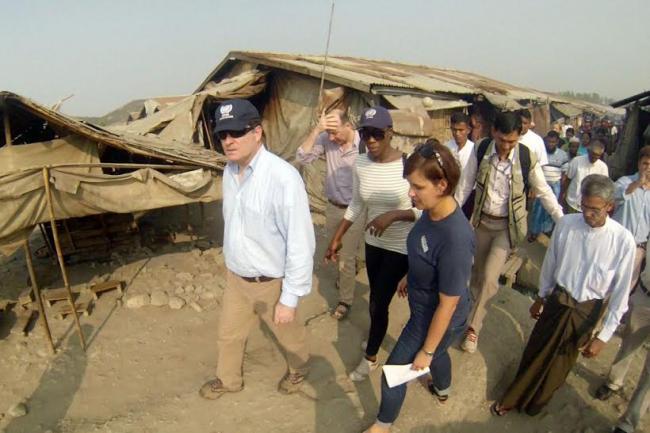
Senior UN relief official calls for end to discrimination against displaced Muslims in Myanmar
More than 100,000 people remain displaced by the ongoing conflict in Kachin and northern Shan States, while some 120,000 Muslims, mainly Rohingya, and 5,000 ethnic Buddhists remain displaced following the inter-communal violence of 2012 in Rakhine state, said John Ging, Director of Operations for the UN Office of the Coordination of Humanitarian Affairs (OCHA), as he briefed the media in New York about his recent visit to the southeast Asian country.
Despite an impressive democratic transformation, which is unlocking significant economic growth and development, “not everyone in Myanmar is benefiting in this transition,” he said.
In Kachin and northern Shan states, over 100,000 people are living in temporary camps, despite the ceasefire signed last October, Ging said. He visited Woi Chyai and Je Yang camps in the non-Government controlled areas, witnessing the senseless loss of life and human suffering caused by the conflict.
Concerns were raised about the proliferation of landmines. Noting that Myanmar has one of the highest numbers of landmine casualties in the world, he stressed that “much more must be done on the landmine issue.”
In Rakhine State, Ging visited internally displaced persons (IDP) camps in Myebon and met people from both Muslim and Buddhist communities, seeing first-hand the humanitarian conditions in the camps. While acknowledging that the State Government has made progress in improving the living conditions for some, Ging expressed shock at seeing so many temporary shelters in a state of collapse and the appalling sanitation conditions.
“It was heart-breaking to see so many children in these dreadful conditions,” said Ging, adding that one mother told him that her baby, less than a month old, died from lack of oxygen in December after she, as a Rohingya Muslim, was denied access to treatment at the nearby township hospital.
“These do not reflect the values of the people of Myanmar or the historical diversity of the country,” he said, warning that “segregation and disenfranchisement are flawed and inhumane policies and history teaches us that they fail every time.”
However, people of both communities have not lost hope of returning to their homes and they still want peaceful coexistence between communities, he said. To make that happen, however, the Government and the international community must work much harder to create the conditions conducive to return, Ging concluded.
Photo: OCHA/P.Peron
Support Our Journalism
We cannot do without you.. your contribution supports unbiased journalism
IBNS is not driven by any ism- not wokeism, not racism, not skewed secularism, not hyper right-wing or left liberal ideals, nor by any hardline religious beliefs or hyper nationalism. We want to serve you good old objective news, as they are. We do not judge or preach. We let people decide for themselves. We only try to present factual and well-sourced news.
Support objective journalism for a small contribution.


