


Southeast Asian nations pledge cooperation on Bay of Bengal migration: UN agency
“Unless conditions improve in their home areas, more people are expected to cross the Bay of Bengal in the coming months, seeking safety and stability in countries in South-East Asia,” according to the Office of the UN High Commissioner for Refugees (UNHCR).
Since 2014, some 95,000 people have made the dangerous journey in the Bay of Bengal – which is bordered by Sri Lanka and India to the west, Bangladesh to the north, and Myanmar and the northern part of the Malay Peninsula to the east – and the Andaman Sea to its southeast, with more than 1,100 dying at sea and hundreds more found buried in unmarked mass graves, according to UNHCR.
“With an unprecedented 60 million persons displaced today, it has become clear that forced displacement issues are a global phenomenon that no country can address or resolve on its own,” said Volker Türk, the UNHCR Assistant High Commissioner for Protection.
Türk, who was in the Thai capital of Bangkok where he was meeting with delegates from more than 20 countries, as well as representatives of international organizations, at the Second Special Meeting on Irregular Migration in the Indian Ocean, also noted “the numbers we are seeing in this region can be managed.”
Countries in the region today affirmed that the only way to reduce loss of life at sea is by working together on comprehensive and sustainable approaches to mixed migration movements.
UNHCR said it hopes that today’s meeting would help set up a regional mechanism to coordinate efforts not just on law enforcement but also on locating and rescuing boats in distress, facilitating passengers to land and providing reception facilities in accordance with States' international obligations.
“Until the refugees among them can return home in a safe, dignified and voluntary way, we will need a creative form of temporary refuge or alternative humanitarian stay that ensures access to health, education [and] work,” said Türk.
“Allowing them to work in labour-importing countries is a win-win: It gives them dignity and self-reliance, and eases the burden on host countries,” he added.
The meeting today took stock of achievements since the previous meeting in late May – when some 5,000 Rohingya and Bangladeshis were eventually disembarked after weeks adrift at sea – in a bid to better prepare for future movements.
Turk noted that on a recent visit to Myanmar’s Rakhine state, he saw progress in seeking solutions for internally displaced people, but had also heard “legitimate grievances” that remained to be addressed, including ensuring fundamental rights such as freedom of movement and access to services.
“We hope that the new Government will give this issue the attention it deserves, in light of the fact that the absence of these rights triggers displacement and has, as a result, international repercussions,” he said.
The refugee agency official also said Sustainable Development Goals offer a framework for addressing root causes and ensuring that no one is left behind in health, education, work and legal identity, among other rights.
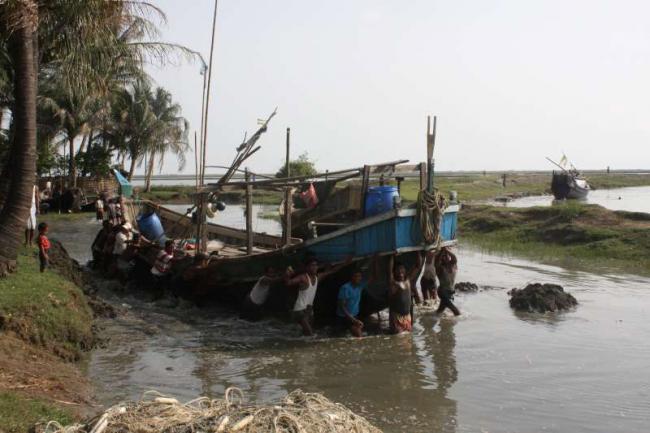
Photo: UNHCR/V. Tan/www.justearthnews.com
Support Our Journalism
We cannot do without you.. your contribution supports unbiased journalism
IBNS is not driven by any ism- not wokeism, not racism, not skewed secularism, not hyper right-wing or left liberal ideals, nor by any hardline religious beliefs or hyper nationalism. We want to serve you good old objective news, as they are. We do not judge or preach. We let people decide for themselves. We only try to present factual and well-sourced news.
Support objective journalism for a small contribution.


