


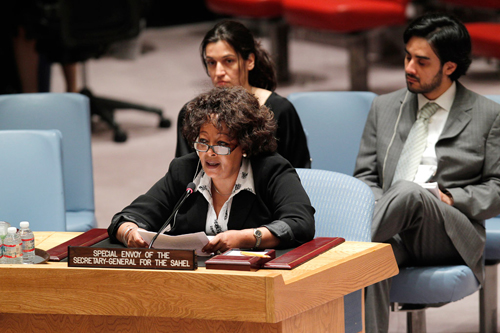
Tackling Sahel challenges requires cooperation: UN envoy
“The deterioration of the political and security situation in the region and beyond constitutes a serious risk of new connections between terrorist groups based in Sahara-Sahel, Nigeria and [East Africa],” said Guebre Sellassie in her first briefing to the Council as Special Envoy for the Sahel.
Ms. Sellassie, updating the Council on the implementation of the year-old UN Integrated Strategy for the diverse but troubled region, which stretches from Mauritania to Eritrea, including Burkina Faso, Chad, Mali, Niger, Nigeria, Senegal and Sudan, cited UN-backed efforts under way to strengthen governance, security and resilience in the countries concerned.
Nevertheless, the Sahel region is still facing enduring political and security challenges which require continued support by the international community and an effective coordination between the existing initiatives in the Sahel.
Specifically, Ms. Sellassie said she has been struck by the deterioration of the political and security situation, notably in Libya, the enduring political and security challenges in Mali, the persistent terrorist attacks throughout the region, notably those carried out by Boko Haram in Nigeria, all of which continue to have negative consequences on civilians and local economies.
“The humanitarian situation remains extremely fragile, at least 20 million people remain at risk of food insecurity and nearly 5 million children are at risk of acute malnutrition,” she said, adding that meanwhile, high levels of youth unemployment in the Sahel increase the appeal of violent ideology.
Against that backdrop, she said, it is clear that efforts to address security challenges in the Sahel within the framework of the UN strategy cannot ignore the interactions between core Sahel countries [Burkina Faso, Chad, Mali, Mauritania, Niger] and North Africa, or between core Sahel and other countries of West and Central Africa.
“The reality on the ground is that North, West and Central Africa form a contiguous geo-political region where short-term as well as mid-and long-term multidimensional responses to various threats to peace and security need be thought of and implemented collectively,” Ms. Sellassie declared.
The Special Envoy reaffirmed UN commitment to continue to support the countries of the region and stressed the importance of the political will of the governments of the region which is critical to an effective implementation of the UN strategy for the Sahel.
“One of the key lessons we learnt from the crisis in Mali is that democratization processes, which translate into internationally-sanctioned elections and efforts towards decentralization, need to be complemented by efforts to strengthen State institutions and better integrate and manage diverse societies,” said Ms. Sellassie, emphasizing that along with “sustained political will,” the strategy must be accompanied by profound political, economic and social transformation in the region.
She went on to say that the formulation of the UN strategy has raised very high expectations among the peoples of the region, requiring tangible benefits for the populations as quickly as possible. “That is why, in implementing the integrated strategy, the UN system will prioritize the inclusion of civil society, tribal and religious leaders, and research institutions.”
Concluding her statement, the Special Envoy revealed that the priority of next year will be to amplify joint action by harmonizing and aligning political, security, development and humanitarian efforts throughout the region.
Special Envoy for the Sahel Guebre Sellassie briefs the Security Council for the first time since her appointment on 1 May 2014. UN Photo/Devra Berkowitz
Support Our Journalism
We cannot do without you.. your contribution supports unbiased journalism
IBNS is not driven by any ism- not wokeism, not racism, not skewed secularism, not hyper right-wing or left liberal ideals, nor by any hardline religious beliefs or hyper nationalism. We want to serve you good old objective news, as they are. We do not judge or preach. We let people decide for themselves. We only try to present factual and well-sourced news.
Support objective journalism for a small contribution.


