


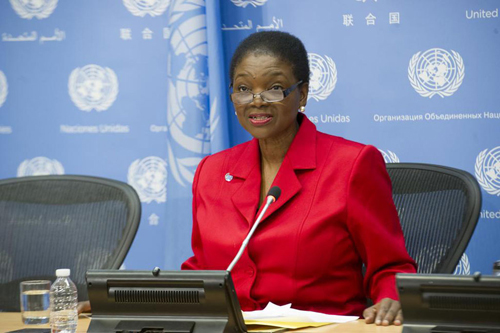
Top UN humanitarian official urges greater effort to foresee, prevent crises
“It is becoming clearer with every large-scale crisis and with the protracted nature of others, that the way we have been doing business is not sustainable,” said Valerie Amos, who is also the UN Under-Secretary-General for Humanitarian Affairs.
Ms. Amos made this stark observation in a wide-ranging address in New York kicking off the UN Economic and Social Council’s (ECOSOC) three-day Humanitarian Affairs segment, an annual platform for Member States, UN agencies, humanitarian and development partners, the private sector and affected communities to discuss new and pressing humanitarian issues.
The theme of this year’s meeting is: “The future of humanitarian affairs: Towards greater inclusiveness, coordination, interoperability and effectiveness.”
"International humanitarian assistance is at a crossroads. The way we work must change,” declared Ms. Amos, noting that more and more people are affected by crises that are increasingly complex and protracted. Moreover, the cost of responding to these crises is escalating rapidly.
Against such a backdrop, she called for greater action to foresee emergencies, prevent them and mitigate their effects. “And we need to do more to address the underlying drivers of conflict and protect people in the midst of them,” she added.
Ms. Amos drew the Council’s attention to the conflicts in Syria, Central African Republic and South Sudan and the widening crisis in Iraq as examples of the urgent for humanitarian assistance, saying that such crises, as well as devastating natural disasters, will continue to proliferate and to worsen due to factors such as growth population, poverty and the effects of climate change.
She said the post-2015 sustainable development agenda, the UN World Summit on Disaster Reduction to be held in 2015 asn well as the UN Framework Convention on Climate Change (UNFCCC), among other forums, offer opportunities to consider these challenges and designing new ways of working in humanitarian aid.
In addition, the discussions this week in ECOSOC also would also provide an opportunity to address these crucial issues, including, among others, the necessary changes in the delivery of humanitarian aid, note Ms. Amos.
Under-Secretary-General for Humanitarian Affairs and Emergency Relief Coordinator Valerie Amos briefs the press. UN Photo/Evan Schneider
Support Our Journalism
We cannot do without you.. your contribution supports unbiased journalism
IBNS is not driven by any ism- not wokeism, not racism, not skewed secularism, not hyper right-wing or left liberal ideals, nor by any hardline religious beliefs or hyper nationalism. We want to serve you good old objective news, as they are. We do not judge or preach. We let people decide for themselves. We only try to present factual and well-sourced news.
Support objective journalism for a small contribution.


