


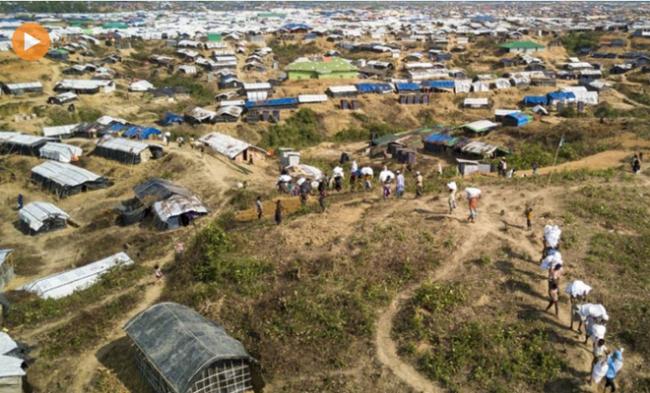
UN agencies helping Rohingya refugee camps brace for potentially devastating rains in southern Bangladesh
New York, Feb 28 (JEN): Against the backdrop of the fast approaching wet season in Bangladesh, United Nations relief agencies are working flat out to strengthen vital infrastructure and boost resilience among hundreds of thousands of Rohingya refugees living in rudimentary shelters as well as for local communities hosting them.
Assessments by the UN International Organization for Migration (IOM) and partners indicate that at least 100,000 refugees and vulnerable families in the local community in Cox’s Bazar – one of the world’s biggest refugee settlements – face life-threatening risks from landslides and floods, and thousands more are at risk of disease and being cut off from assistance.
“With emergency situations inevitable when the rains hit, it is crucial we work together now to limit disaster as much as possible before it occurs,” Manuel Marques Pereira, the IOM Emergency Coordinator in Cox’s Bazar, said in a news release Tuesday
“We need to be able to respond swiftly and effectively during crisis events.”
Preparation efforts include providing search and rescue training; setting up emergency medical centres; establishing bases for work crews and light machinery; and upgrading shelters to mitigate disasters. Work is also ongoing to improve roads and drainage, stabilize slopes (to prevent landslides and erosion) and setting up early warning systems.
In addition, IOM has created disaster risk reduction safety committees to warn refugees of what to expect and how to prepare for the wind and rain that are expected to bring deadly floods and landslides.
“It is vitally important to support members of the refugee and local communities with training and information in advance, so they are ready to respond and protect themselves and others when the worst conditions arrive,” added Mr. Marques Pereira.
But given the scale of the challenges, including the sheer size of the refugee population, limited suitable land, and harsh environmental conditions, it will be impossible to move everyone at risk, and therefore rapid emergency response action will be critical to save lives.
To improve response, an emergency drill is being conducted on Thursday (1 March) to develop rapid and coordinated operations, which is being attended by IOM, the Office of the UN High Commissioner for Refugees (UNHCR), humanitarian partners and Government agencies.
Since late August 2017, some 700,000 members of Myanmar’s minority Muslim Rohingya community have been driven from their homes due to brutal and widespread violence in Myanmar’s Rakhine province, joining some 200,000 Rohingya refugees displaced earlier.
Together with local host communities, the number of persons in need of humanitarian assistance in the region is estimated to number over a million.
UNHCR/Roger Arnold
Support Our Journalism
We cannot do without you.. your contribution supports unbiased journalism
IBNS is not driven by any ism- not wokeism, not racism, not skewed secularism, not hyper right-wing or left liberal ideals, nor by any hardline religious beliefs or hyper nationalism. We want to serve you good old objective news, as they are. We do not judge or preach. We let people decide for themselves. We only try to present factual and well-sourced news.
Support objective journalism for a small contribution.


