


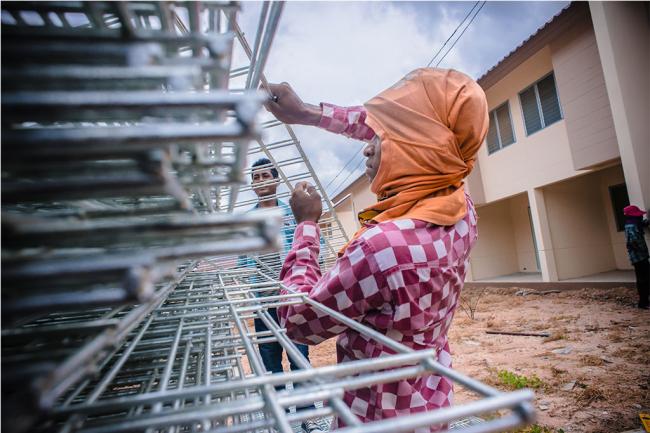
UN agency data on labour migration shows 160 million migrants in global workforce
“Decision makers will now have real data on which to base their policies,” said International Labour Organization (ILO) Director-General Guy Ryder in a news release.
He said that this analysis will help countries deliver on the 2030 Agenda’s Sustainable Development Goals (SDGs), particularly targets within Goal 8 on protecting all workers, including migrant workers, and Goal 10 on the implementation of well-managed migration policies.
The report, ILO Global Estimates on Migrant Workers, found that there are 232 million international migrants, of which 206.6 million are 16 years old and up. Of this working-age migrant population, 72.7 per cent, or 160 million, are migrant workers. And 83.7 million are men and 66.6 million women.
Labour migration is a phenomenon that concerns all regions of the world, however, almost half, or 48.6 per cent, of migrant workers are concentrated in two broad regions: Northern America, and Northern, Southern and Western Europe. The Arab States have the highest proportion of migrant workers as a share of all workers with 36.6 per cent.
In Jordan, the ILO supports national partners in improving working conditions and employment contracts for migrant workers in the garment sector. Photo: ILO/Sami Haven
The study also examines the distribution of the migrant workforce in broad industry groupings. The vast majority of migrant workers are in the services sectors, with 106.8 million workers accounting for 71.1 per cent of the total, followed by industry, including manufacturing and construction, with 26.7 million, or 17.8 per cent, and by agriculture with 16.7 million, or 11.1 per cent. Among all migrant workers, 7.7 per cent are domestic workers.
“This estimate study shows that the vast majority of migrants migrate in search of better job opportunities,” said Manuela Tomei, Director of the ILO’s Conditions of Work and Equality Department (WORKQUALITY). “By applying a robust methodology we believe it will add significantly to our knowledge base on migration and provide a strong foundation for the development of effective migration policies.”
The report also highlights the significant global numbers of migrant domestic workers and the marked gender disparities in this sector. Domestic work is one of the least regulated sectors of the economy and, as such, is of particular concern to the ILO, the news release said, noting that due to the concentration of migrant women workers and relatively low visibility of the workforce in this sector multiple forms of discrimination often intersect.
Of the estimated 67.1 million domestic workers in the world, 11.6 million, or 17.2 per cent are international migrants. About 73.4 per cent, or around 8.6 million, of all migrant domestic workers are women. South-Eastern Asia and the Pacific host the largest share, with 24 per cent of the global number of female migrant domestic workers, followed by Northern, Southern and Western Europe, with 22.1 per cent of the total, and the Arab States with 19 per cent.
Photo: ILO/John Hulme
Source: www.justearthnews.com
Support Our Journalism
We cannot do without you.. your contribution supports unbiased journalism
IBNS is not driven by any ism- not wokeism, not racism, not skewed secularism, not hyper right-wing or left liberal ideals, nor by any hardline religious beliefs or hyper nationalism. We want to serve you good old objective news, as they are. We do not judge or preach. We let people decide for themselves. We only try to present factual and well-sourced news.
Support objective journalism for a small contribution.


