


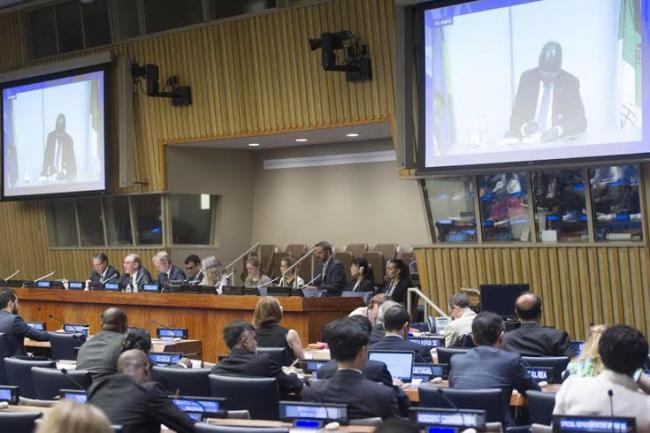
UN deputy chief urges ramped-up support for global peacebuilding efforts
Addressing the opening of the Second Annual Session of the Peacebuilding Commission at UN Headquarters in New York, the Deputy Secretary-General emphasized the role of peacebuilding at “the core of UN activities in conflict-affected countries” but warned that financing efforts for peacebuilding still remained woefully insufficient.
“We do not know exactly how large the financing gap for peacebuilding is, since there are no global estimates of peacebuilding needs. But there are clear indications that allocations to peacebuilding and to institution-building – which is closely related – in conflict-affected countries are grossly inadequate,” Eliasson confirmed.
The UN deputy head told those gathered that in a group of 31 conflict-affected countries, critical institution-building in the political, security and justice areas received less than 10 per cent of official development assistance (ODA) during the period 2002-2013. For the six countries on the agenda of the Peacebuilding Commission Burundi (Sierra Leone, Guinea, Guinea-Bissau, Liberia and Central African Republic), only 7 per cent of ODA was allocated to these areas.
“This shortfall affects our ability to build and consolidate peace with short term and targeted support to national processes and plans,” he continued.
In addition to the funding shortfalls, Eliasson pointed out that existing funding mechanisms among donors remained “fragmented” as development, security, human rights and humanitarian activities are often funded from different budgets with separate decision-making processes.
On the recipient side, the funding mechanisms remain equally scattered across separate funds and “a multitude of plans and strategies on the part of governments, the UN system and other actors on the ground” which, he added, “do not contribute to coherence and a clear focus.”
One option to countering such a piecemeal approach would be to enhance the UN Peacebuilding Fund, Eliasson said, citing the global pooled fund which had already played “a positive role in breaking down the silos” among UN missions and country teams in areas such as the Central African Republic.
However, compounding the problem related to fragmentation, the Deputy Secretary-General also noted the lack of robust tax and rule of law institutions in many countries emerging from conflict, cautioning that this only added to the burden facing an effective mobilization of domestic resources.
He suggested that this alone made the need for early and sustained investment in capacity building by the international community “even more critical.”
“We need to make sure that the Peacebuilding Fund is placed on a solid footing,” Eliasson concluded. “The Fund has a valuable role to play as a global pooled fund that brings together the political, security and development aspects of peacebuilding.”
Photo/Mark Garten
Support Our Journalism
We cannot do without you.. your contribution supports unbiased journalism
IBNS is not driven by any ism- not wokeism, not racism, not skewed secularism, not hyper right-wing or left liberal ideals, nor by any hardline religious beliefs or hyper nationalism. We want to serve you good old objective news, as they are. We do not judge or preach. We let people decide for themselves. We only try to present factual and well-sourced news.
Support objective journalism for a small contribution.


