


UN experts warn against release of former commander convicted in Srebrenica genocide
The experts’ call comes after the Bosnian Constitutional Court overturned the verdict and ordered a retrial.
“The release of convicted criminals undermines efforts made by the Bosnian State Court and the international community to achieve justice, especially in light of the wider failure by the Government to adopt and implement a comprehensive transitional justice strategy,” the experts jointly said in a press release published by the UN Office of the High Commissioner for Human Rights (OHCHR).
The experts include Pablo de Greiff, Special Rapporteur on the promotion of truth, justice, reparation and guarantees of non-recurrence; Ariel Dulitzky, Chair-Rapporteur, Working Group on Enforced or Involuntary Disappearances; Juan E. Méndez, Special Rapporteur on torture and other cruel, inhuman or degrading treatment or punishment; and Gabriela Knaul, Special Rapporteur on the Independence of Judges and Lawyers.
Mr. Trbic was charged in April 2005 by the UN war crimes tribunal for the former Yugoslavia (ICTY) with crimes against humanity for his role in planning and carrying out the massacre in 1995 of 1,000 Bosnian Muslim men from Srebrenica. Mr. Trbic joined the Bosnian Serb Army (VRS) when the war in Bosnia started. He was found guilty of genocide by the Court of Bosnia and Herzegovina in October 2009.
Emphasizing the necessity of ensuring that the rights of victims to truth and justice are respected, the experts also called on the Government of Bosnia and Herzegovina to take “all necessary steps” to protect victims and adopt a comprehensive transitional justice strategy as a matter of priority.
The experts noted that the Bosnian Constitutional Court has overruled more than a dozen other convictions for war crimes and aiding genocide throughout the past year, following its “highly questionable” legal interpretation of the European Court of Human Rights judgment in Maktouf and Damjanovic.
“Each decision has led to a prisoner’s release pending retrial and retrials have led to much lower sentences,” the experts stressed.
“There is a grave risk that the convicted criminal will flee to another jurisdiction, as happened recently in the case of war criminal Novak Ðukic,” they added. Ðukic, a former commander of the Bosnian Serb Army’s Ozren Tactical Group, was sentenced to 20 years in prison for ordering an artillery squad to shell the town of Tuzla in 1995.
This is the first case that concerns someone convicted not for having aided but for having directly committed genocide, which makes the decision “even more alarming,” the experts said.
Moreover, the experts noted that the interests of justice require that people convicted of genocide, crimes against humanity, war crimes and other serious crimes, including torture and enforced disappearances, whose guilt is not in question, should not be released pending retrial and that punishment should be consistent with the gravity of the offence.
“Such decisions are a slap in the face for victims and pose serious challenges with regard to the protection of victims from violence, re-victimization and intimidation,” said the experts, who have previously engaged with the Government of Bosnia and Herzegovina on these issues.
The experts also said that “these decisions feed into a disturbing narrative propagated in some quarters that those convicted of war crimes and genocide have been unfairly targeted,” and warned that “this type of discourse seriously risks any prospects for reconciliation.”
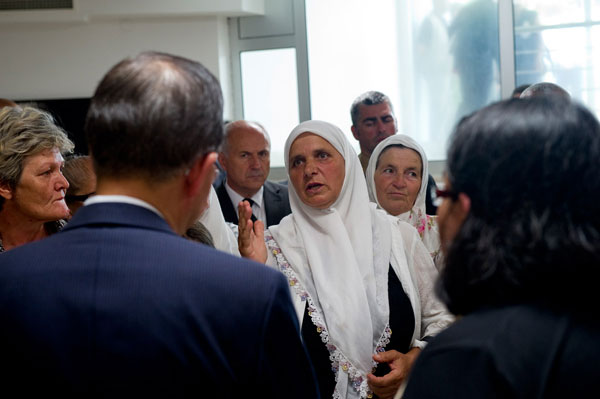
On a visit in July 2012 to the memorial site for the victims of the 1995 massacre in Srebrenica, Secretary-General Ban Ki-moon (back to camera) meets with victims’ families. UN Photo/Eskinder Debebe (file)
Support Our Journalism
We cannot do without you.. your contribution supports unbiased journalism
IBNS is not driven by any ism- not wokeism, not racism, not skewed secularism, not hyper right-wing or left liberal ideals, nor by any hardline religious beliefs or hyper nationalism. We want to serve you good old objective news, as they are. We do not judge or preach. We let people decide for themselves. We only try to present factual and well-sourced news.
Support objective journalism for a small contribution.


