


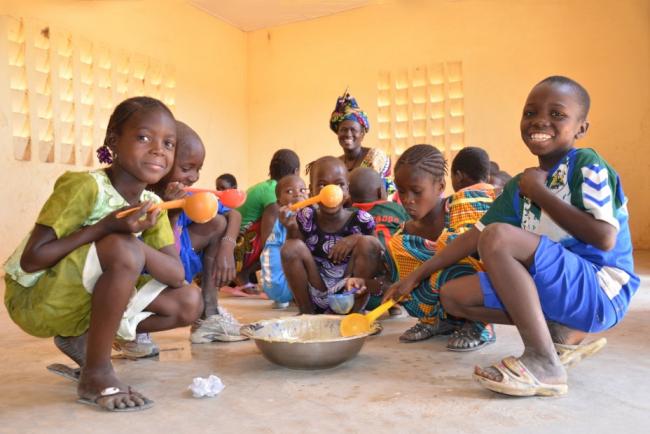
UN food relief agency needs $48 million for school meals programme in West and Central Africa
“Children from the very countries and regions where needs are most acute are missing out on this vital assistance. We urge our supporters not to forget the value the school meals programme brings – a key vehicle to reduce poverty, hunger and malnutrition – and not let more than a million children slip deeper or back into in poverty and hunger,” the World Food Programme’s Regional Director for West Africa, Abdou Dieng, said in a news release.
“We urgently need US$48 million to start or continue our school meals assistance,” he added.
In the news release, WFP note that dwindling resources, shifting donor priorities and changed financing mechanisms in some countries have conspired to create a funding gap and jeopardize programmes. However, unless vital funding comes through in the next month, more than half a million children across Cameroon, Mali, Mauritania and Niger could start the school year without the meals they have come to rely upon and, by the end of 2016, assistance will run out for a further 700,000 children in 11 other countries.
School meals have been a lifeline for children
WFP is the top sponsor of such initiatives in West and Central Africa. While in some countries the government and other agencies lead or complement the UN agency’s programme, in most of the region WFP is the sole or main provider of school meals, targeting areas where hunger and malnutrition levels are highest. Year after year, the agency noted, it has been forced by financial constraints to shrink its areas of coverage.
“In most countries in West and Central Africa – in the grip of chronic hunger and malnutrition, and increasingly affected by conflict – school meals have been a lifeline for children, as they are often the only regular and nutritious meals they receive,” said Dieng.
In Chad – where, in some regions, as many as four-fifths of the population do not get enough food for a healthy life – WFP’s school meals programme has shrunk by more than 90 per cent in the past three years due to funding shortages, from more than 200,000 children assisted in 2013 to just 15,000 in 2016. In Senegal, current resources will cover school meals for less than a fifth of the children targeted by the programme. In Mauritania and Cameroon, funds ran out during the 2015-2016 school year, forcing WFP to halt assistance in January and May respectively. In Guinea, WFP will halve its assistance this school year.
WFP also flagged that during or after conflict in the Central African Republic, Mali and Niger, or in the aftermath of a major health crisis such as the Ebola outbreak, school meals have played an important role in providing children in need with nutritious meals; encouraging families to send their children to school; and, more broadly, helping children regain their childhood.
Key donors to WFP’s school meals programme in West and Central Africa for the 2015-2016 school year are Canada, the European Union, Japan, Luxembourg, Saudi Arabia and the United States.
Photo: WFP/Daouda Guirou
Source: www.justearthnews.com
Support Our Journalism
We cannot do without you.. your contribution supports unbiased journalism
IBNS is not driven by any ism- not wokeism, not racism, not skewed secularism, not hyper right-wing or left liberal ideals, nor by any hardline religious beliefs or hyper nationalism. We want to serve you good old objective news, as they are. We do not judge or preach. We let people decide for themselves. We only try to present factual and well-sourced news.
Support objective journalism for a small contribution.


