


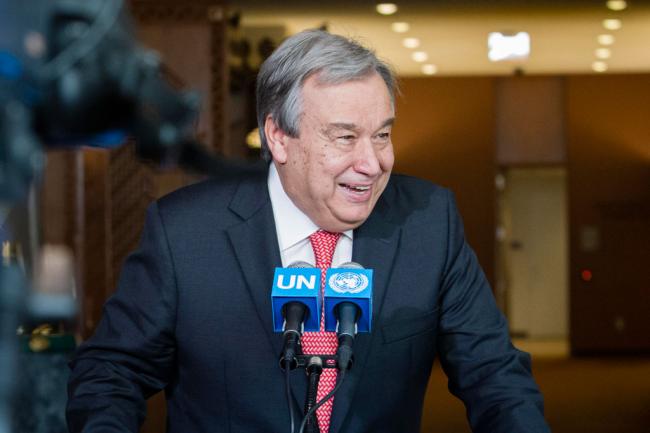
UN Member States set to appoint next Secretary-General
Guterres, aged 67, was Prime Minister of Portugal from 1995 to 2002, and the UN High Commissioner for Refugees from June 2005 to December 2015.
If the Security Council’s recommendation is confirmed, Guterres will succeed current Secretary General, Ban Ki-moon, of the Republic of Korea, who was appointed in 2006 and will leave the post at the end of this year.
The new Secretary-General will assume the role in January 2017 and will serve a five year term, which can be renewed by Member States for an additional five years.
On an official visit to Italy, last week when the Council forward its decision to the Assembly, Ban said in Rome that Guterres is “an excellent choice," noting that the two had worked closely during Mr. Guterres “long and outstanding tenure” as the UN High Commissioner for Refugees.
Under procedures for appointing the world body’s new chief, after the recommendation is transmitted from the Council to the Assembly, a draft resolution is issued for the Assembly to take action. After appropriate consultations with Member States, the Assembly President fixes a date for the draft to be taken up.
The last five Secretaries-General were appointed by the Assembly through a resolution adopted by consensus. A vote will take place only if a Member State requests it and a simple majority of those voting would be required for the Assembly to adopt the resolution. But the Assembly could decide that the decision requires a two-thirds majority. If a vote is taken, it will be by secret ballot.
The UN Charter, signed in 1945 as the foundation of the Organization, says relatively little about how a Secretary-General is to be selected, aside from Article 97, which notes that the candidate “shall be appointed by the General Assembly upon the recommendation of the Security Council.”
At its first session in 1946, the General Assembly was much more active in the selection process. It created resolution A/RES/1/11 determining that the Council take the lead in the selection process, agree on a single name in a private meeting, and pass that name down to the General Assembly for a vote.
In addition to Guterres, 12 other candidates were in the running for the position.
Action in the Assembly will culminate an historic process: the selection of a new United Nations Secretary-General, traditionally decided behind closed-doors by a few powerful countries, has for the first time, involved public discussions with each candidate campaigning for the world’s top diplomatic post.
These so-called ‘informal briefings’ between the candidates, UN Member States and civil society representatives kicked off on 12 April, when the first three candidates presented their ‘vision statements’ and answered questions on how they would promote sustainable development, improve efforts to create peace, protect human rights, and deal with huge humanitarian catastrophes should they be selected to lead the Organization.
In addition, this past July, the UN held its first-ever globally televised and webcast townhall-style debate in the General Assembly Hall, where the confirmed candidates at the time took questions from diplomats and the public at large.
UN Photo/Manuel Elias
Source: www.justearthnews.com
Support Our Journalism
We cannot do without you.. your contribution supports unbiased journalism
IBNS is not driven by any ism- not wokeism, not racism, not skewed secularism, not hyper right-wing or left liberal ideals, nor by any hardline religious beliefs or hyper nationalism. We want to serve you good old objective news, as they are. We do not judge or preach. We let people decide for themselves. We only try to present factual and well-sourced news.
Support objective journalism for a small contribution.


